Zing Forum

Reading

ECG Signal Classification Using 1D-CNN and TCN: From Deep Learning to FPGA Edge Deployment

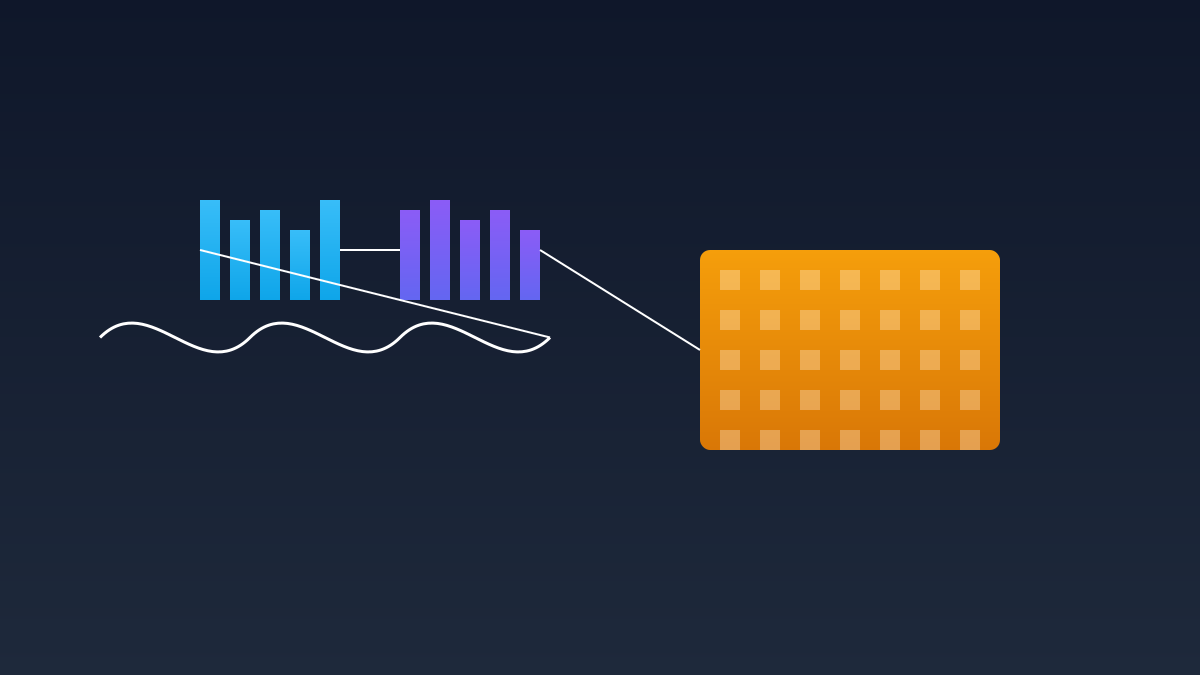
This project combines 1D Convolutional Neural Networks (1D-CNN) and Temporal Convolutional Networks (TCN) for ECG signal classification, and has been successfully deployed on an FPGA-SoC hardware platform, enabling edge computing applications for medical AI.

ECG信号分类1D-CNN时序卷积网络TCNFPGA-SoC边缘计算医疗AI深度学习部署
Published 2026-04-28 11:16Recent activity 2026-04-28 11:28Estimated read 6 min
ECG Signal Classification Using 1D-CNN and TCN: From Deep Learning to FPGA Edge Deployment
1

Section 01

[Main Floor] Project Guide: ECG Classification Using 1D-CNN+TCN and FPGA Edge Deployment

This project combines 1D Convolutional Neural Networks (1D-CNN) and Temporal Convolutional Networks (TCN) to achieve ECG signal classification, and has been successfully deployed on an FPGA-SoC hardware platform to build an end-to-end solution for medical AI edge computing. It addresses issues such as data privacy and network latency in traditional cloud-based solutions, supporting real-time diagnosis.


2

Section 02

Project Background and Motivation

Cardiovascular diseases are a leading cause of death globally. Traditional ECG analysis relies on doctors' experience and is inefficient; deep learning improves diagnostic consistency but is difficult to deploy on resource-constrained devices. FPGAs have advantages such as strong parallel computing, low power consumption, and reconfigurability. The Xilinx KV260/KR260 MPSoC integrates ARM processors and FPGA logic, making it an ideal platform for edge AI.

3

Section 03

Analysis of Core Technical Architecture

Data Source and Preprocessing: Adopt the public ECG dataset from KaggleHub, processed via filtering (removing baseline drift/power line interference), normalization, and segmentation into fixed windows. 1D-CNN Design: 1D convolution kernels capture local temporal features of ECG (e.g., QRS complexes), and multi-layer convolution and pooling extract abstract features. TCN Integration: Expand receptive fields via dilated convolution, mitigate gradient vanishing with residual connections to model long-term dependencies; the hybrid architecture of 1D-CNN and TCN complements each other to improve classification performance.

4

Section 04

Model Training and Optimization Strategies

Training Strategy: Supervised learning optimized with cross-entropy loss, using Dropout and data augmentation (adding noise/time shifts) for regularization; dynamic learning rate adjustment + early stopping to prevent overfitting. Compression and Quantization: Reduce parameter count via pruning and knowledge distillation; convert floating-point to fixed-point quantization to lower storage and computation costs, balancing model size, speed, and accuracy.

5

Section 05

FPGA-SoC Deployment Details

Hardware Selection: Xilinx KV260/KR260 MPSoC (ARM processor handles control/preprocessing, FPGA accelerates inference). Deployment Process: Convert the model to Vitis AI's DPU format, perform operator fusion/memory optimization/pipeline design, compile into a bitstream and burn it to the FPGA. Performance Evaluation: Compare with cloud models, evaluate metrics such as classification accuracy, inference latency, power consumption, and throughput; achieve low-latency edge inference with acceptable accuracy loss.

6

Section 06

Core Value of Medical AI Edge Computing

Real-time Performance: Local instant analysis meets low-latency requirements for scenarios like emergency care. Data Privacy: Local processing avoids the risk of sensitive medical data leakage from uploading. Cost-effectiveness: No long-term cloud service fees, and not limited by network connectivity.

7

Section 07

Project Summary and Future Outlook

The project achieves high-precision ECG classification and FPGA edge deployment, providing a reference for the industrialization of medical AI. In the future, we will develop dedicated medical AI chips and combine federated learning to enable multi-institution data sharing for training, improving the model's generalization ability.

