Zing 论坛

正文

Orla:哈佛开源的高性能多智能体系统执行引擎

来自哈佛大学计算机科学实验室的开源项目Orla,为构建和运行基于大语言模型的多智能体系统提供了统一的执行框架。通过分离工作流决策与请求执行,Orla实现了跨异构模型的高效调度和协调。

multi-agentLLMworkfloworchestrationharvardopen-sourceKV-cacheinference
发布时间 2026/04/02 10:15最近活动 2026/04/02 10:21预计阅读 5 分钟
Orla:哈佛开源的高性能多智能体系统执行引擎
1

章节 01

Orla: Harvard Open-Source High-Performance Multi-Agent Execution Engine - Core Overview

Orla is an open-source project from Harvard's Computer Science Laboratory (Harvard CNS) Minlan Yu教授团队, providing a unified execution framework for building and running LLM-based multi-agent systems. Its core design principle is separating workflow decision-making from request execution, enabling efficient scheduling and coordination across heterogeneous models. Key features include support for heterogeneous model routing, workflow orchestration with fault tolerance, and cross-stage KV cache management to boost inference efficiency.


2

章节 02

Background: Engineering Dilemmas in Multi-Agent Systems

As LLM capabilities evolve, multi-agent applications shift from single dialogue to complex multi-step workflows. Manual orchestration of model calls, tool executions, and infrastructure brings challenges:

  1. Tight coupling between workflow decision logic and execution, making maintenance/extension hard.
  2. Lack of unified abstraction for scheduling across models/backends, requiring custom adapters.
  3. Complex state management (e.g., KV cache sharing/reuse) needing custom implementations.
3

章节 03

Orla's Three Core Components

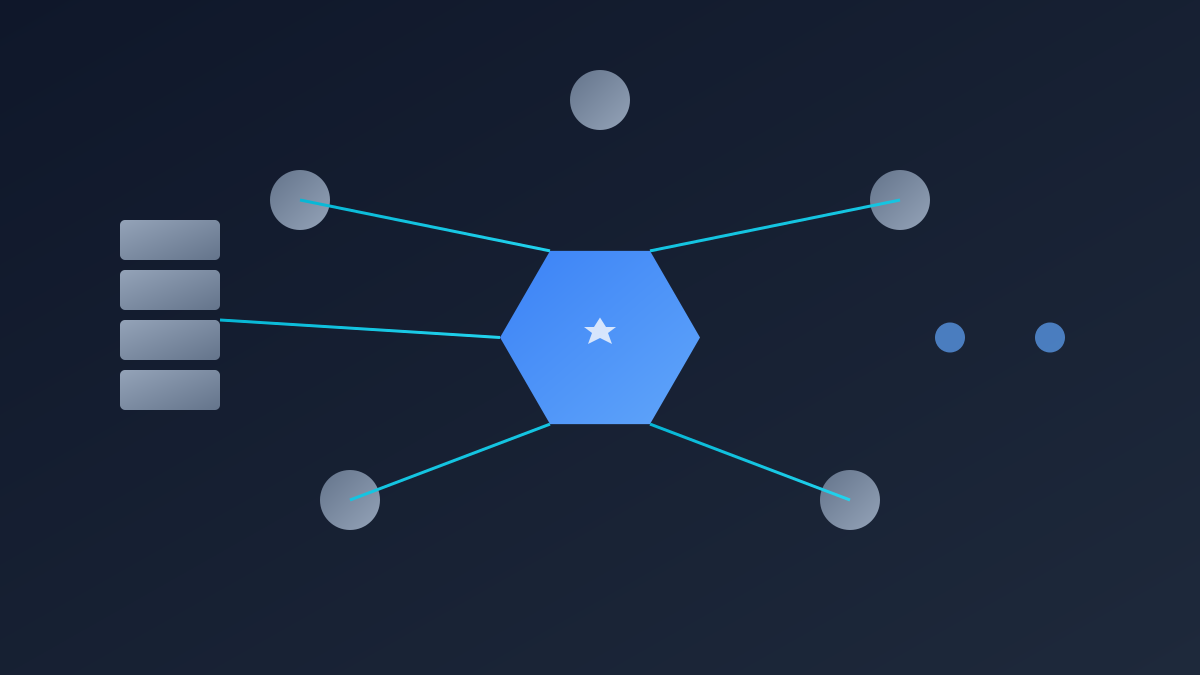
Orla's architecture centers on three components:

  • Stage Mapper: Maps workflow stages to suitable models/backends via declarative requirements, optimizing resource use (e.g., GPU for intensive tasks, CPU for simple ones).
  • Workflow Orchestrator: Coordinates execution order/dependencies, supports parallel/conditional/loop execution, and has fault tolerance (retry/recovery).
  • Memory Manager: Manages KV cache across stages, enabling reuse to reduce redundant computation and improve inference efficiency in multi-step scenarios.
4

章节 04

Technical Implementation & Ecosystem Integration

Orla uses Go for its core engine (high performance, low resource use) and provides a Python SDK (pyorla) for easy integration. Installation methods:

  • Daemon: brew install --cask harvard-cns/orla/orla
  • Python SDK: pip install pyorla This dual-language approach balances performance and accessibility.
5

章节 05

Key Application Scenarios of Orla

Orla is suitable for:

  • Complex dialogue systems: KV cache reuse reduces latency in multi-round conversations.
  • Tool call workflows: Orchestrates tool order/dependencies and routes to appropriate backends.
  • Multi-model collaboration: Unifies orchestration for scenarios like code generation → review → documentation.
6

章节 06

Academic Background & Community Contribution

Orla is backed by academic research, with a paper Orla: A Library for Serving LLM-Based Multi-Agent Systems on arXiv (authors: Rana Shahout, Hayder Tirmazi, Minlan Yu, Michael Mitzenmacher). It's open-source, with contribution guidelines and GitHub Issues for community interaction.

7

章节 07

Summary & Future Outlook of Orla

Orla represents a shift from manual to declarative, high-performance multi-agent execution frameworks. By separating concerns, providing unified abstractions, and optimizing KV cache management, it lays a solid foundation for production-grade multi-agent apps. As LLM applications expand, such engines will become critical for lowering development barriers and ensuring performance/reliability. Teams building multi-agent systems should consider evaluating Orla.

