Zing 论坛

正文

OpenGrid:去中心化点对点大模型推理网络

OpenGrid提出了一种基于志愿者计算的去中心化大语言模型推理网络架构,允许普通用户通过贡献计算资源获得推理积分,旨在构建开放、民主化的AI基础设施。

去中心化AI点对点网络志愿者计算LLM推理分布式系统开源基础设施计算资源共享
发布时间 2026/04/23 03:13最近活动 2026/04/23 03:25预计阅读 10 分钟
OpenGrid:去中心化点对点大模型推理网络
1

章节 01

OpenGrid: Decentralized Peer-to-Peer LLM Inference Network - Overview

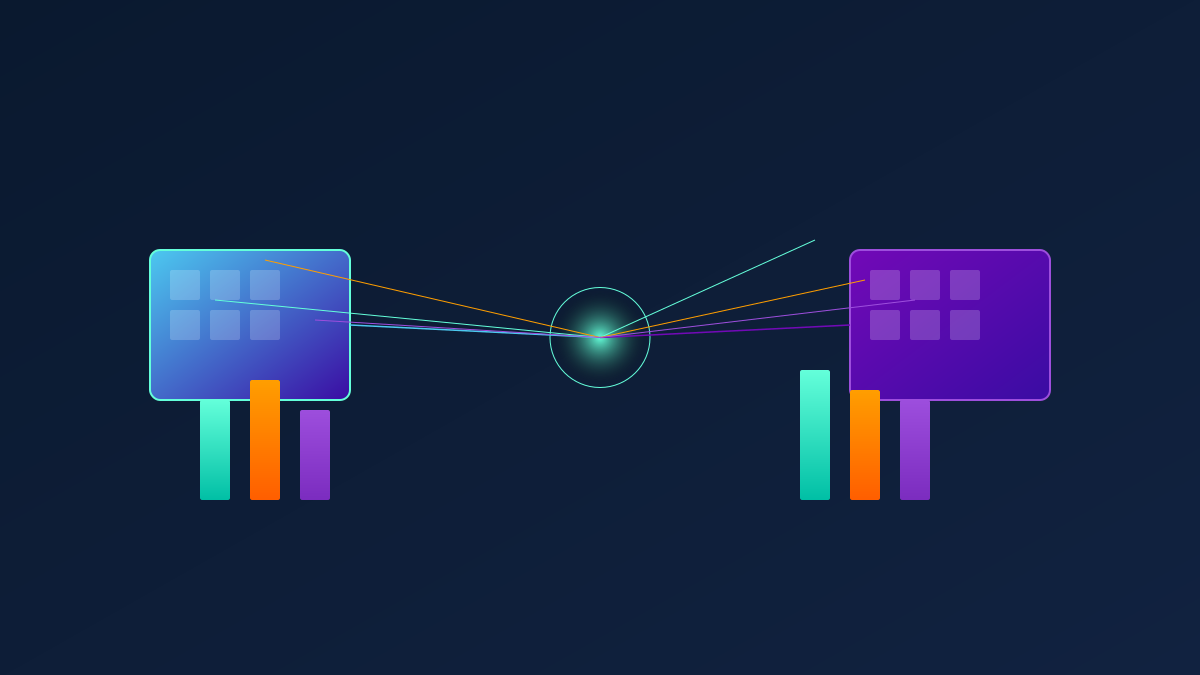
OpenGrid is a decentralized peer-to-peer large language model (LLM) inference network based on volunteer computing. It allows ordinary users to contribute computing resources (consumer PCs, gaming GPUs, multi-core CPUs) to earn inference points, aiming to build an open and democratized AI infrastructure. This project addresses key issues in centralized AI infrastructure, such as high API costs, data privacy risks, service availability dependencies, and monopolistic control over AI development.


2

章节 02

Project Background & Core Vision

With the rapid growth of LLM capabilities, AI inference demand is increasing exponentially. However, current AI infrastructure is highly centralized, controlled by a few tech giants. This centralization brings problems like high API costs, data privacy risks, service availability dependencies, and monopolistic control over AI development.

OpenGrid proposes a new approach: building a decentralized, peer-to-peer LLM inference network where ordinary users can contribute their computing resources and get corresponding rewards. This 'volunteer computing' model is similar to distributed computing projects like SETI@home but applied to the AI inference field.

3

章节 03

Core Architecture & Key Mechanisms

Volunteer Computing Nodes

Any user with suitable hardware can join as a node: hardware requirements include consumer PCs (modern CPU), gaming GPUs (NVIDIA/AMD), multi-core CPU servers, and stable network connections. Node types: edge nodes (run lightweight models for simple tasks), work nodes (GPU-equipped for heavy loads), coordination nodes (task distribution and result aggregation).

Task Distribution & Scheduling

  • Load balancing: dynamically allocate tasks based on node computing power, current load, and network latency.
  • Fault tolerance: execute tasks on multiple nodes and compare results to ensure quality.
  • Priority queues: support different priority queues for real-time and cost-sensitive applications.

Incentive Mechanism

  • Inference points: nodes earn points proportional to computing resources and time contributed.
  • Point usage: exchange for inference services, trade in the market, or donate to open-source AI projects.
  • Reputation system: high-quality, high-availability nodes get higher task priority.

Privacy & Security

  • Data encryption:全程加密 during transmission and computation.
  • Differential privacy: optional mechanism for data protection.
  • Model protection: use model sharding and secure multi-party computation to prevent weight extraction.
  • Verification: detect and punish malicious nodes via redundant computing and result comparison.
4

章节 04

Technical Implementation & Challenges

Technical Implementation Path

OpenGrid is currently in the architecture design phase, with complete specifications open-sourced on GitHub. Key areas:

  • Network layer: based on libp2p or similar decentralized protocols for node discovery and communication.
  • Consensus mechanism: lightweight algorithm for point recording and reputation management (low energy consumption).
  • Model service: support multiple inference engines (llama.cpp, vLLM, TensorRT-LLM) for different hardware.
  • Client SDK: multi-language SDK for developer integration.

Challenges & Solutions

  1. Variable computing quality: dynamically match tasks (complex tasks to high-performance nodes, simple to ordinary nodes).
  2. Malicious nodes: combine redundant verification, reputation system, and economic penalties.
  3. Model IP protection: use model sharding, homomorphic encryption, and trusted execution environments (TEE).
  4. Network stability: fast task rescheduling, state checkpoints, and graceful degradation.
5

章节 05

Application Scenarios & Comparison

Application Scenarios

  1. Low-cost AI access: economical alternative to commercial APIs for budget-limited developers/startups.
  2. Privacy-sensitive applications: data processed locally or on trusted nodes to protect privacy.
  3. Edge computing: low-latency AI services via geographically distributed nodes.
  4. Model crowdsourced training: extend incentives to federated learning (contribute data/computing resources).
  5. Anti-censorship communication: decentralized network is hard to control or shut down.

Comparison with Existing Solutions

特性 OpenGrid 商业API 本地部署 传统分布式计算
成本 低(积分交换) 高(按token计费) 中(硬件成本) 免费(志愿贡献)
隐私 高(加密+本地) 低(数据外流) 最高(完全本地) 中(依赖项目)
可用性 中(依赖节点) 高(SLA保障) 高(自主控制) 低(志愿性质)
去中心化 完全去中心化 完全中心化 单机 部分去中心化
模型选择 社区决定 提供商决定 用户决定 项目决定
激励机制 积分经济 商业付费 荣誉/科学贡献
6

章节 06

Community Participation & Future Outlook

Open Source Community

OpenGrid uses MIT/Apache-2.0 dual licenses. Ways to participate:

  • Read the full specification (OpenGrid.md).
  • Propose features or report issues in Issues.
  • Join community discussions in Discussions.
  • Submit Pull Requests for code/documentation.

Needed contributions: network protocol implementation, encryption/security solutions, client SDK development, economic model design, testing/validation.

Future Outlook

If successful, OpenGrid will:

  • Lower AI access barriers for global developers/users.
  • Promote AI innovation (support experimental and niche projects).
  • Enhance AI resilience (resist single-point failures and censorship).
  • Drive sustainable computing (utilize idle resources to improve efficiency).
7

章节 07

Summary & Final Thoughts

OpenGrid is an ambitious open-source project that aims to redefine AI infrastructure via decentralization and volunteer computing. While facing multiple challenges (technical, economic, governance), its core idea—making AI computing resources more open and democratized—has significant social value.

For readers interested in AI infrastructure, decentralized technology, and open-source communities, OpenGrid is worth following. Its success will greatly impact the accessibility and diversity of future AI services.