Zing 论坛

正文

NeuroSense:生产级多模态情感识别系统,融合文本、语音与深度学习的微服务架构实践

本文详细介绍NeuroSense多模态情感识别系统,该系统采用RoBERTa和Wav2Vec2模型分别处理文本和音频输入,通过加权晚期融合实现90%以上的识别准确率,并基于FastAPI和Streamlit构建了完整的微服务架构,为情感计算领域提供了可参考的工程实现范式。

多模态情感识别情感计算RoBERTaWav2Vec2FastAPIStreamlit微服务架构晚期融合语音情感文本情感
发布时间 2026/04/04 15:10最近活动 2026/04/04 15:20预计阅读 6 分钟
NeuroSense:生产级多模态情感识别系统,融合文本、语音与深度学习的微服务架构实践
1

章节 01

NeuroSense: Core Overview of a Production-Grade Multi-Modal Emotion Recognition System

NeuroSense is a production-grade multi-modal emotion recognition system that integrates text and audio inputs using RoBERTa and Wav2Vec2 models respectively. It achieves over 90% recognition accuracy via weighted late fusion and is built on a micro-service architecture with FastAPI and Streamlit, providing a reference engineering paradigm for the emotion computing field.


2

章节 02

Background & Motivation for Multi-Modal Emotion Recognition

Emotion computing is shifting from academic research to practical applications. However, single-modal emotion recognition is limited by insufficient information—text may hide true emotions, voice intonation conveys unspoken feelings, and facial expressions can be disconnected from context. NeuroSense's core insight is that true emotion understanding requires combining text semantics and acoustic features to mimic human emotional perception.

3

章节 03

Key Technical Challenges in Multi-Modal Emotion Recognition

Building a production-ready multi-modal emotion system faces several challenges:

  1. Modal heterogeneity: Text (discrete symbols) and audio (continuous waveforms) have different feature spaces and information densities.
  2. Time alignment: Speech-text transcription may be misaligned, requiring precise timing for effective fusion.
  3. Model complexity vs. inference efficiency: Balancing accuracy and low latency for production.
  4. Data scarcity: High-quality multi-modal labeled data is rare, limiting end-to-end training.
4

章节 04

NeuroSense System Architecture

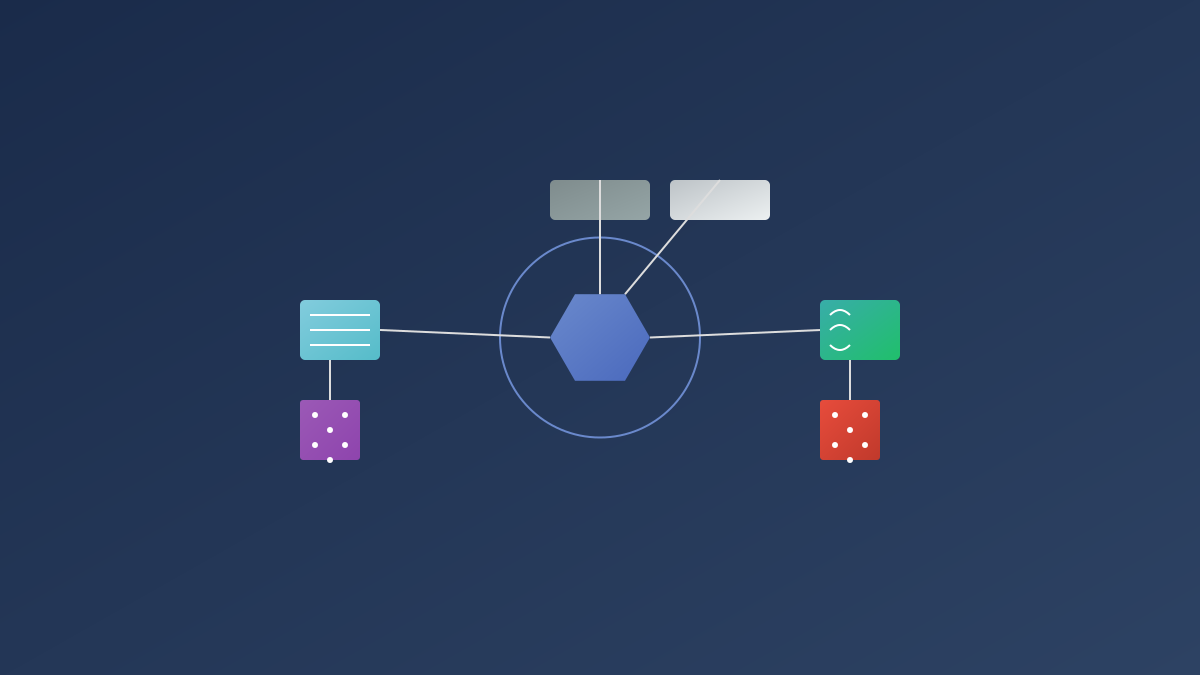
NeuroSense uses a micro-service architecture with three core layers:

  • Streamlit Frontend: Interactive web interface for uploading audio/text and viewing results, communicating with backend via REST API.
  • FastAPI Backend: Asynchronous RESTful API with PyTorch-based inference (GPU-accelerated) and four endpoints (health check, text/audio/multi-modal analysis).
  • Supabase PostgreSQL: Stores predictions (input mode, dominant emotion, confidence, probability distribution, inference latency) for analysis and monitoring.
5

章节 05

Dual-Branch Model for Text & Audio Processing

NeuroSense employs a dual-branch model:

  • Text Branch: Uses j-hartemann/emotion-english-distilroberta-base (RoBERTa-based) to map text to 7 Ekman emotions, achieving ~86% accuracy on MELD.
  • Audio Branch: Uses superb/wav2vec2-base-superb-er (Wav2Vec2-based) for speech emotion recognition, with ~67% weighted accuracy on IEMOCAP. Both branches run independently, supporting single/multi-modal inputs and future modal extensions.
6

章节 06

Weighted Late Fusion Strategy

NeuroSense uses weighted late fusion at the decision layer: text (55%) and audio (45%) probability distributions are weighted and summed for final prediction. This strategy offers modularity (update branches independently), handles missing modes (degrade to single-modal), and is easy to maintain.

7

章节 07

Engineering & Deployment Details

Key engineering practices:

  • Model Service: Pre-trained models loaded once at startup to reduce latency.
  • Async Processing: FastAPI's async design improves throughput.
  • Error Handling: Degrades to single-modal if one mode fails.
  • Logging: All predictions stored in Supabase for performance analysis. Deployment: Render.com with render.yaml (IaaC), environment variables for sensitive data, scalable micro-services.
8

章节 08

Applications, Limitations & Future Directions

Applications: Customer service (real-time emotion monitoring), mental health (clinical auxiliary tool), education (student feedback analysis), market research (focus group emotion extraction). Limitations: English-only, no context modeling, cultural bias, privacy concerns. Future: Multi-language support, context-aware analysis, cross-cultural adaptation, stronger privacy measures.