Zing 论坛

正文

MotifAI:跨框架的 Agent 编排元框架与可观测性实践

MotifAI 是一个 Python 原生的 Agent 编排元框架,支持将工作流定义编译为 LangGraph、CrewAI 和 AutoGen 运行时,并内置延迟、内存和循环可观测性,为复杂 AI 工作流提供统一的抽象与监控能力。

Agent编排元框架LangGraphCrewAIAutoGen可观测性工作流编译多框架
发布时间 2026/06/15 23:46最近活动 2026/06/16 00:23预计阅读 10 分钟
MotifAI:跨框架的 Agent 编排元框架与可观测性实践
1

章节 01

MotifAI: Cross-framework Agent Orchestration Meta-framework (导读)

MotifAI: Cross-framework Agent Orchestration Meta-framework and Observability Practice

MotifAI is a Python native Agent orchestration meta-framework that supports compiling workflow definitions into LangGraph, CrewAI, and AutoGen runtimes, with built-in observability for delays, memory, and loops. It provides a unified abstraction and monitoring capability for complex AI workflows, addressing the fragmentation issue of existing Agent frameworks.

Author & Source

This thread will explore its background, core design, key features, application scenarios, technical implementation, and future outlook.


2

章节 02

Background: Engineering Dilemma of Agent Framework Fragmentation

Background: Agent Framework Fragmentation带来的工程困境

From 2024 to 2025, the AI Agent field experienced explosive growth with frameworks like LangGraph, CrewAI, AutoGen, PydanticAI, and LlamaIndex emerging, each with unique design philosophies and applicable scenarios. However, this prosperity hides a tricky engineering problem: framework fragmentation.

Development teams often face dilemmas: choosing a framework initially but finding another more suitable as requirements evolve, leading to code rewrites, API re-learning, and state management redesign. Worse, different frameworks' observation and debugging tools are incompatible, forcing teams to maintain multiple monitoring systems.

This fragmentation increases technical debt and limits architectural flexibility. Integrating multiple frameworks (e.g., LangGraph for state machines, CrewAI for role collaboration, AutoGen for multi-agent dialogue) becomes extremely complex without a unified abstraction layer.

3

章节 03

Core Design: Meta-framework & Unified Workflow Abstraction

Core Positioning: Meta-framework & Compiler

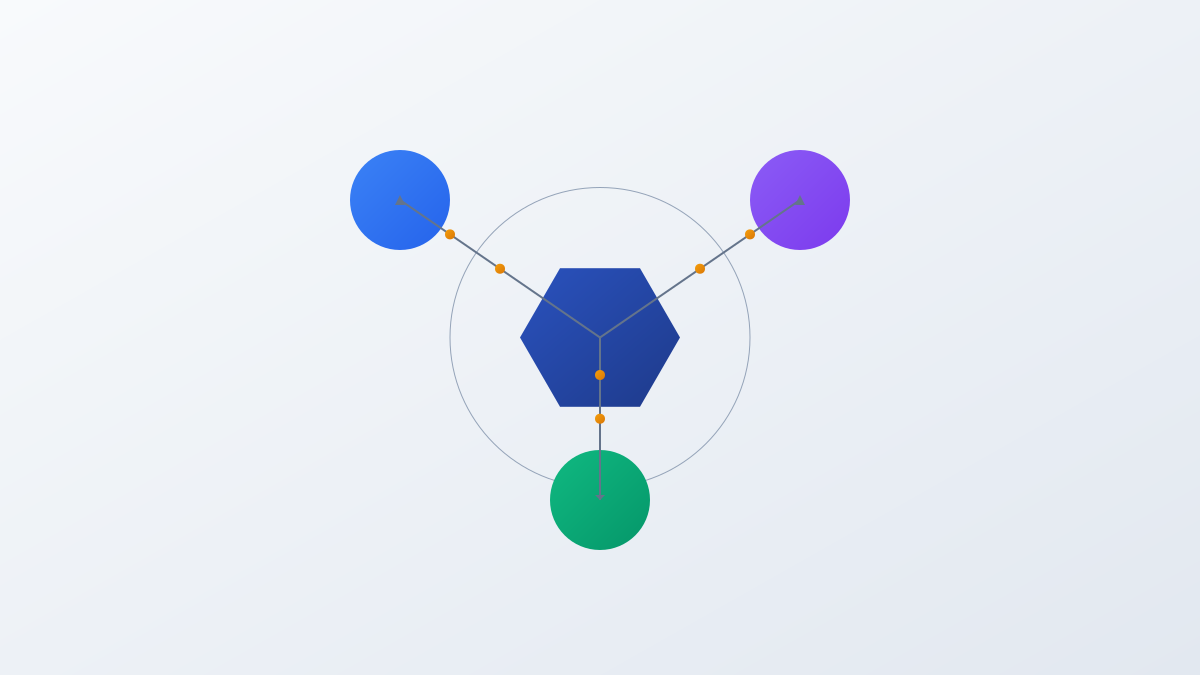
MotifAI positions itself as a 'meta-framework' with core innovation in introducing a runtime-agnostic workflow abstraction layer. Developers define workflows using MotifAI's DSL or Python API, then the compiler converts them into executable code for target frameworks. This design draws inspiration from advanced compiler ideas in programming languages (like LLVM compiling high-level languages to multiple machine codes). Currently, it supports LangGraph, CrewAI, and AutoGen, with future expansion plans.

Workflow Abstraction: Unified Multi-framework Semantics

MotifAI defines a set of general Agent workflow primitives with corresponding implementations across target frameworks:

  • Agent Definition: Describes role, capabilities, tools, and memory configuration, mapped to each framework's Agent class.
  • Task Orchestration: Supports sequential execution, parallel branches, conditional branches, loops, converted to state machines or graph representations.
  • Message Passing: Defines communication modes (direct call, message queue, broadcast) and handles framework-specific communication differences.
  • Memory Management: Abstracts short-term working memory and long-term persistent memory, mapped to each framework's memory implementation.

This unified abstraction allows developers to design workflows consistently without deep diving into each framework's details.

4

章节 04

Observability: Delay, Memory & Loop Monitoring

Observability: Deep Insights into Workflow Execution

MotifAI's built-in observability system addresses the debugging and optimization challenges of Agent workflows:

  • Delay Tracking: Records time consumption of each Agent call, tool execution, and reasoning round, generating end-to-end delay breakdown graphs to identify bottlenecks.
  • Memory Monitoring: Tracks memory usage during workflow execution (context window, intermediate result cache, long-term memory retrieval) — crucial for resource-constrained environments.
  • Loop Detection: Monitors execution paths to detect abnormal loops, providing interruption and recovery mechanisms.

These observation data are exposed via a unified API, integrable with Prometheus, Grafana, or specialized AI observability platforms.

5

章节 05

Practical Application Scenarios

Key Application Scenarios

MotifAI is suitable for various complex scenarios:

  • Multi-framework Hybrid Architecture: Combine frameworks (e.g., LangGraph for state machines, CrewAI for role collaboration) with unified management and monitoring.
  • Framework Migration & Evaluation: Generate implementations for two frameworks simultaneously to conduct A/B testing and performance comparison, reducing migration risk.
  • Enterprise-level Agent Platform: Support multiple teams using different frameworks with a unified abstraction layer and governance interface.
  • Research & Experimentation: Quickly try features of different frameworks, lowering experimental costs for academia and industrial research.
6

章节 06

Technical Implementation Details

Technical Implementation

MotifAI is implemented natively in Python, leveraging Python's dominance in the AI ecosystem. Its compiler architecture has three layers:

  • Frontend: Parses workflow definitions, performs syntax/semantic checks, and generates intermediate representation (IR).
  • IR Layer: A framework-agnostic graph structure capturing complete workflow semantics.
  • Backend: Converts IR to target framework code, handling API mapping and runtime integration.

Observability is achieved via compile-time monitoring code injection. MotifAI automatically inserts tracking points in generated code to collect execution data without invading core business logic (transparent instrumentation).

7

章节 07

Future Outlook & Ecological Significance

Future Outlook & Conclusion

MotifAI represents an important direction in Agent infrastructure evolution. As framework numbers grow, demand for unified abstraction and interoperability increases. Its meta-framework approach provides an elegant solution to this challenge.

Future plans include expanding support to more frameworks (PydanticAI, LlamaIndex Workflows, Dify) and forming a shared workflow library around its IR standard to boost development efficiency.

For teams building Agent applications, MotifAI offers a new option to reduce technical lock-in risk and enhance architectural flexibility. It reminds us that abstraction and layering are effective weapons against complexity in fast-changing technical fields.

