Zing Forum

Reading

Building an End-to-End Customer Churn Prediction System: Practical Integration of XGBoost, SMOTE, and SHAP Explainable AI

This article provides a detailed analysis of the complete implementation of an industrial-grade customer churn prediction system, covering the entire workflow from synthetic data generation, class imbalance handling, XGBoost model training to SHAP explainable analysis, and enables real-time interactive prediction via a Streamlit glassmorphism dashboard.

客户流失预测XGBoostSMOTESHAP可解释AIStreamlit机器学习类别不平衡玻璃拟态设计客户留存
Published 2026-05-02 14:15Recent activity 2026-05-02 14:19Estimated read 6 min
Building an End-to-End Customer Churn Prediction System: Practical Integration of XGBoost, SMOTE, and SHAP Explainable AI
1

Section 01

[Introduction] End-to-End Customer Churn Prediction System: Practical Integration of XGBoost, SMOTE, and SHAP

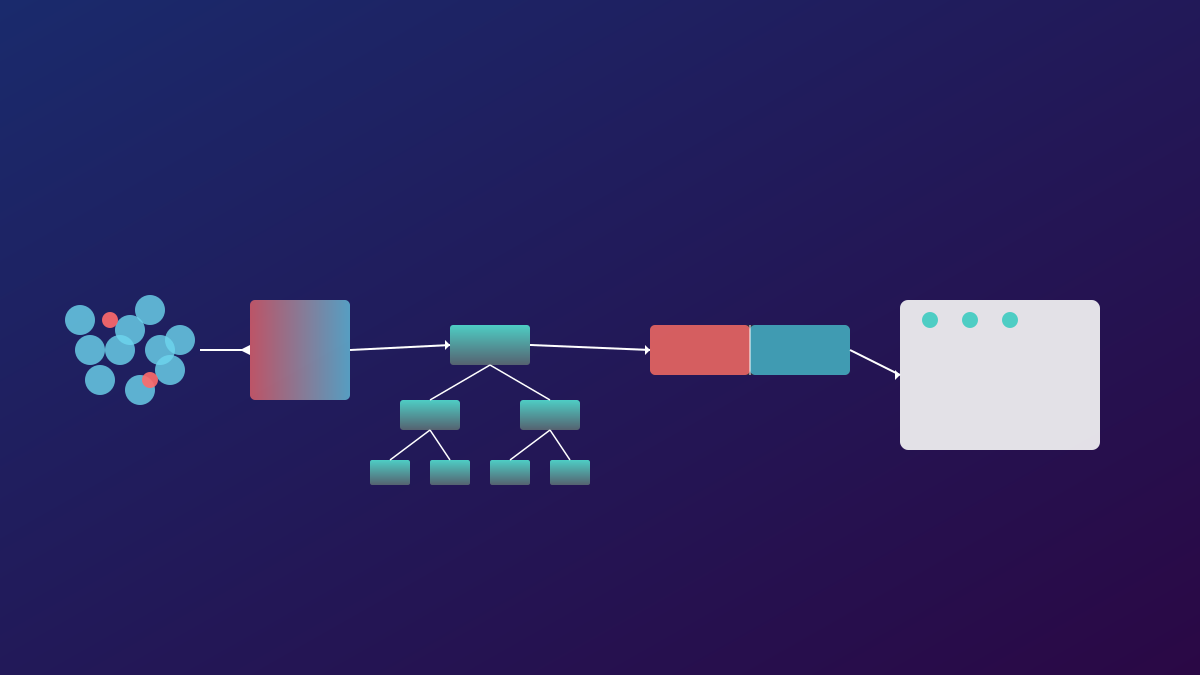
In today’s subscription-based business landscape, customer churn prediction is one of the core tasks for enterprises (acquisition cost is 5-25 times higher than retention cost). The open-source system analyzed in this article implements an end-to-end ML pipeline: synthetic data generation → class imbalance handling (SMOTE) → XGBoost model training → SHAP explainable analysis, and provides real-time interactive prediction through a Streamlit glassmorphism dashboard, balancing technical depth and business落地 value.


2

Section 02

Project Background and Core Features

The core goal of customer churn prediction is to accurately identify high-risk customers to enhance profitability. The core features of this system include:

  1. Synthetic data generation module: Creates synthetic data with complex correlations (privacy protection + easy demonstration);
  2. XGBoost core algorithm: Suitable for tabular data with robust performance;
  3. SMOTE for class imbalance: Mitigates the scarcity of churn samples;
  4. SHAP explainable AI: Displays feature contributions to predictions;
  5. Streamlit deployment: Interactive web app with glassmorphism design.
3

Section 03

Data Engineering: From Synthetic to Realistic Construction

Data generation uses a carefully designed probabilistic model to simulate real customer behavior, covering demographics, account info, usage behavior, billing info, etc., and models feature correlations (e.g., long-term contract customers have higher tenure). Preprocessing steps include missing value handling, category encoding (One-Hot/Label), and numerical feature standardization, laying the foundation for model training.

4

Section 04

Class Imbalance Solution: Application of SMOTE

In customer churn scenarios, churn samples account for only 5%-20% of total samples. Direct training easily leads to model bias. SMOTE generates synthetic samples via interpolation in feature space (not simple duplication), expands the decision boundary of the minority class, balances the ratio of positive and negative samples in the training set, and provides a fair learning environment for XGBoost.

5

Section 05

Model Training and Interpretability: XGBoost + SHAP

XGBoost advantages: Automatically captures non-linear feature interactions, outputs feature importance, uses regularization to prevent overfitting, and natively handles missing values. SHAP assigns feature contributions based on Shapley values, shows each feature’s impact on prediction results via waterfall charts (e.g., "high monthly fee" positively drives churn, "long contract term" negatively suppresses it), and generates global feature importance charts.

6

Section 06

Interactive Deployment: Streamlit Glassmorphism Dashboard

The web app is built using the Streamlit framework, with glassmorphism design features: semi-transparent frosted effect, gradient background, neon light effect, and Lottie animation. Functions include: 3D scatter plot for customer distribution exploration, radar chart for customer profile display, correlation heatmap, real-time prediction (returns churn probability + SHAP explanation), and dashboard risk level display.

7

Section 07

Business Value and Application Scenarios

The system’s business value is reflected in:

  1. Revenue protection: Early intervention for high-risk customers;
  2. Precision marketing: Concentrate resources on groups needing intervention;
  3. Product optimization: Feedback on churn drivers via SHAP (e.g., frequent technical support implies product usability issues);
  4. Customer success: Prioritize handling high-value high-risk customers.
8

Section 08

Summary and Future Outlook

This system is an ML engineering example integrating advanced algorithms and modern deployment, suitable for learning and implementation. Future expansion directions: Introduce real-time data stream processing, integrate customer feedback closed loop, explore deep learning models, and connect to CRM systems for automated marketing triggers. Core design concepts (technology serves business, interpretability builds trust, user experience drives adoption) will continue to guide iterations.

