
Zing Forum

Reading

Vertica Expert Skills: A One-Stop Guide to Enterprise Database Migration and Optimization

An in-depth analysis of dingqiangliu's open-source Vertica Expert Skills project, covering complete migration solutions from Oracle, DB2, SQL Server, PostgreSQL, and MySQL to Vertica, including core capabilities such as OLTP-to-OLAP rewrite patterns, stored procedure development, user-defined functions, and in-database machine learning.

Vertica数据库迁移OLTPOLAPOracleSQL ServerPostgreSQLMySQLDB2列式数据库
Published 2026-06-02 23:15Recent activity 2026-06-02 23:19Estimated read 7 min
Vertica Expert Skills: A One-Stop Guide to Enterprise Database Migration and Optimization
1

Section 01

Introduction: Core Overview of the Vertica Expert Skills Project

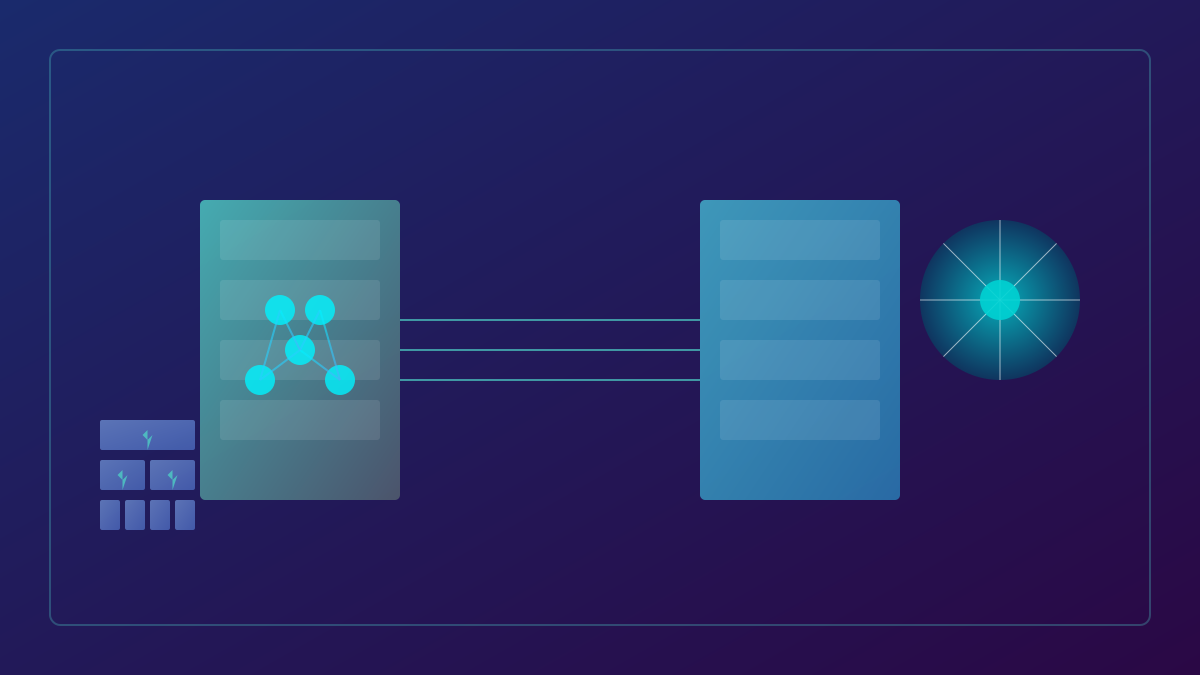
Introducing dingqiangliu's open-source vertica-expert-skill project, which provides complete migration solutions from Oracle, DB2, SQL Server, PostgreSQL, and MySQL to Vertica. It covers core capabilities such as OLTP-to-OLAP rewrite patterns, stored procedure development, user-defined functions (UDx), and in-database machine learning, aiming to solve pain points in database migration like syntax differences, logic rewriting, and performance optimization. The project is sourced from GitHub (link: https://github.com/dingqiangliu/vertica-expert-skill) and was released on June 2, 2026.

2

Section 02

Background: Why Vertica Migration Skills Are Needed

In the big data era, enterprises face challenges in massive data analysis. Traditional OLTP databases (e.g., Oracle, SQL Server) struggle with large-scale analytical queries. As a columnar database, Vertica has excellent query performance and horizontal scalability, making it the first choice for data warehouses. However, migration has bottlenecks like syntax differences, stored procedure logic rewriting, and performance optimization. This project provides a systematic migration methodology and toolset to address these issues.

3

Section 03

Core Migration Methodology and Project Structure

The project uses a modular structure. Core documents include SKILL.md (capability overview), README.md (quick start), and 17 reference guides (series on migration, development, optimization, etc.). The migration methodology has two steps: 1. Follow general requirements (sequential processing, full migration, object-by-object verification, dependency integrity, performance baseline); 2. Master OLTP→OLAP rewrite patterns (5 patterns such as cursor to window function, merging loop DML into set operations, etc.).

4

Section 04

Detailed Support for Multi-Source Database Migration

The project provides specialized migration guides for different databases:

  • Oracle: Split PL/SQL packages into independent functions, rewrite trigger logic, flatten object types;
  • SQL Server: Convert temporary tables, rewrite system stored procedures, adjust transaction control;
  • DB2: Module conversion, convert MQT to projections, map special registers;
  • PostgreSQL: Adjust PL/pgSQL to PL/vSQL, expand composite types;
  • MySQL: Schema optimization, query rewriting, remove storage engine-specific hints.
5

Section 05

PL/vSQL Stored Procedures and UDx Development

PL/vSQL supports IN/OUT/INOUT parameters, control structures, exception handling, and dynamic SQL. Best practices include avoiding row-by-row processing and using projection optimization. UDx supports C++ (high performance), Python (rapid development), Java (enterprise integration), and R (statistical computing). Function types cover scalar, aggregate, analytical, and transform.

6

Section 06

In-Database Machine Learning Capabilities

Vertica supports the full machine learning workflow within the database, including:

  • Algorithms for regression (linear, XGBoost, random forest, etc.), classification (logistic regression, XGBoost classification, etc.), clustering (K-Means, etc.), and time series (AR, MA, ARIMA);
  • Data preprocessing (missing value filling, encoding, etc.), model training, evaluation, deployment, and monitoring.
7

Section 07

Practical Application Scenarios and Project Value

Application scenarios include: 1. Oracle data warehouse migration for financial enterprises; 2. Construction of real-time sales analysis platforms for e-commerce; 3. Multi-source data integration for manufacturing enterprises. Project value: Systematic architecture reconstruction thinking, reusable standardized documents, knowledge precipitation, and reduced migration risk.

8

Section 08

Usage Recommendations and Summary

Usage steps: 1. Run install.sh to install; 2. Learn the general migration guide and OLTP→OLAP rewrite guide; 3. Evaluate the complexity of the source database; 4. Pilot migration of non-critical modules; 5. Full migration; 6. Optimize performance; 7. Verify functionality and performance. This project provides systematic guidance for database administrators, data engineers, etc., helping to leverage Vertica's analytical advantages.

