Zing Forum

Reading

VectorSense: An Autonomous Hexacopter Gas Leak Detection System Based on Physics-Informed Neural Networks

VectorSense is an autonomous hexacopter UAV system designed specifically for industrial facilities. By integrating electrochemical sensors, thermal imaging, and ultrasonic detection technologies, combined with Physics-Informed Neural Networks (PINN), it achieves precise identification of hazardous gas leaks, source localization, and cost assessment.

物理信息神经网络PINN六旋翼无人机气体泄漏检测工业物联网自主巡检多模态传感化工安全机器学习机器人技术
Published 2026-05-03 01:45Recent activity 2026-05-03 01:47Estimated read 7 min
VectorSense: An Autonomous Hexacopter Gas Leak Detection System Based on Physics-Informed Neural Networks
1

Section 01

Introduction to the VectorSense System: An Industrial Gas Leak Detection Solution with Autonomous Hexacopter + PINN

VectorSense is an autonomous hexacopter UAV system designed for industrial facilities. It integrates electrochemical sensors, thermal imaging, and ultrasonic detection technologies, combined with Physics-Informed Neural Networks (PINN) to achieve precise identification of hazardous gas leaks, source localization, and cost assessment. It solves the problems of low efficiency and high risk in traditional manual inspection, providing an intelligent solution for industrial safety monitoring.


2

Section 02

Background and Pain Points of Industrial Gas Leak Detection

In modern chemical, petroleum refining, and other industries, hazardous gas leaks are major hidden dangers threatening personnel safety and environmental health. Traditional manual inspection is inefficient and puts workers in high-risk environments. With the development of UAV technology and artificial intelligence, autonomous industrial inspection solutions have become the focus of the industry, and VectorSense is a typical representative of this trend.

3

Section 03

Hardware Architecture Design of VectorSense

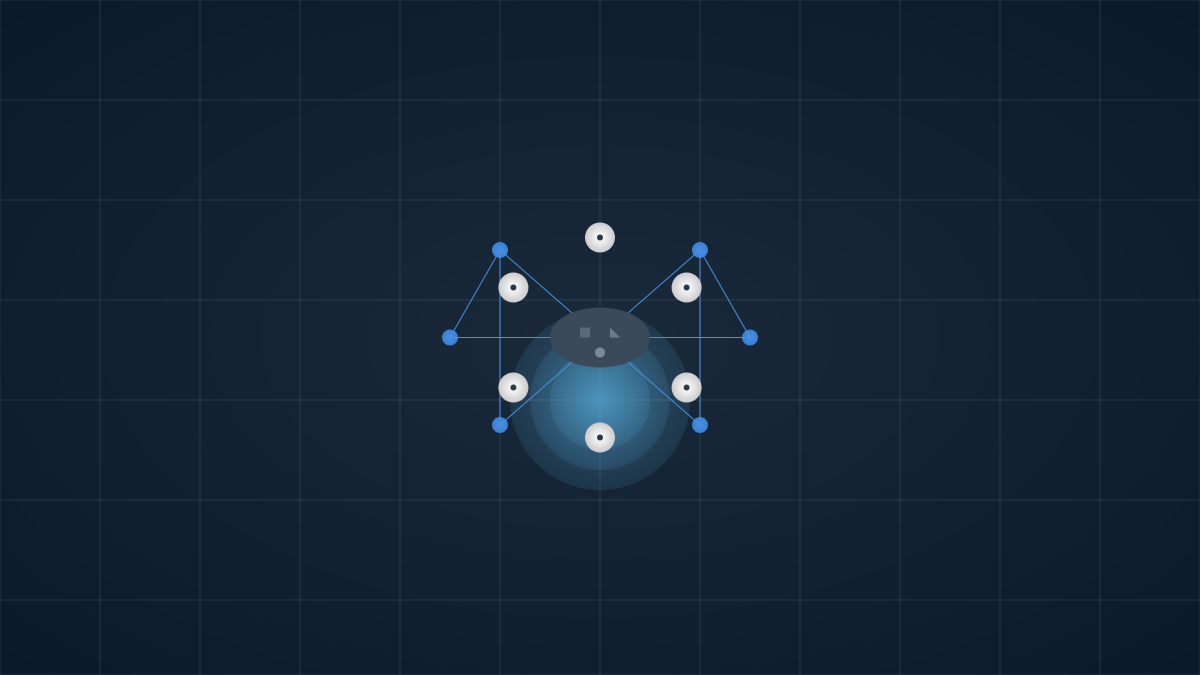
VectorSense adopts a hexacopter configuration, which has higher load capacity and flight stability than quadcopters, making it suitable for operations in complex industrial environments. The core sensing modules include: an electrochemical sensor array to detect specific gas components and concentrations; a thermal imaging camera to capture temperature anomalies and find potential leak points; and an ultrasonic transmitter to detect high-frequency sound waves from high-pressure gas leaks. Multi-modal data fusion ensures reliable detection capabilities in different environments.

4

Section 04

Core Role of Physics-Informed Neural Networks (PINN)

VectorSense innovatively introduces PINN to model the gas diffusion process. Traditional pure data-driven models lack physical law constraints and have limited generalization ability; PINN embeds the advection-diffusion partial differential equation of gas diffusion (∂C/∂t + u·∇C = ∇·(D∇C) + S) into the loss function, integrating domain knowledge into training. It receives real-time sensor data and environmental parameters to invert the leak source position, type, and rate, solving the difficulties of traditional inverse problems.

5

Section 05

Cost Assessment and Decision Support Functions

VectorSense has economic analysis capabilities, which can estimate the hourly regulatory cost based on the detected gas type, leak rate, and duration. This function helps enterprises quantify the economic impact of safety risks, scientifically allocate maintenance resources, avoid high fines, and enhance their social responsibility image, reflecting the comprehensive value of modern Industrial Internet of Things (IIoT) systems.

6

Section 06

Typical Application Scenarios of VectorSense

It is suitable for refineries (high-risk points such as catalytic cracking units and oil storage tank areas), chemical plants (toxic and hazardous gas process units), and natural gas processing facilities (the chain from wellhead to purification devices). The system autonomously flies along preset routes for inspection, timely detects hidden dangers, avoids personnel entering dangerous areas, and adapts to diverse environments.

7

Section 07

Technical Challenges and Future Outlook

Practical deployment faces challenges such as navigation obstacle avoidance, real-time data fusion processing, and PINN training data acquisition (limited by safety and privacy). In the future, data issues can be solved through transfer learning and simulation data generation; wider deployment can be achieved by combining edge computing and 5G networks; integration with digital twin technology can predict equipment degradation trends and realize proactive prevention.

8

Section 08

Conclusion: Innovative Direction of Industrial Safety Monitoring

VectorSense integrates UAV hardware, multi-modal sensing, and PINN algorithms to build an end-to-end autonomous inspection solution, which has reference value for the fields of Industrial Internet of Things, AI applications, and robotics. Its open-source code lays the foundation for community contributions and technical iteration, and we look forward to more similar innovative practices emerging.

