Zing Forum

Reading

Deep Learning Image Classifier Based on TensorFlow and Keras: Intelligent Fruit and Vegetable Recognition System

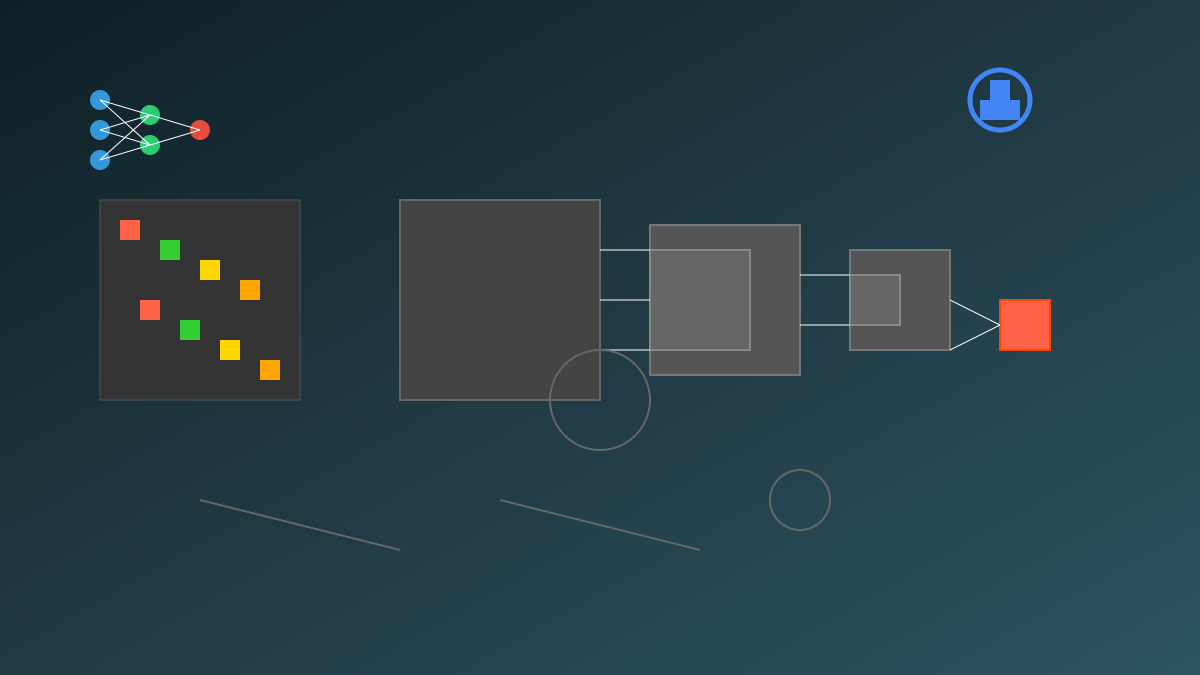
This article introduces a deep learning image classification project built using TensorFlow and Keras. The project can accurately identify whether an input image belongs to the fruit or vegetable category through Convolutional Neural Networks (CNN), demonstrating the practical application of deep learning in the field of computer vision.

深度学习图像分类TensorFlowKeras卷积神经网络CNN计算机视觉机器学习人工智能水果蔬菜识别
Published 2026-05-01 00:44Recent activity 2026-05-01 00:48Estimated read 7 min
Deep Learning Image Classifier Based on TensorFlow and Keras: Intelligent Fruit and Vegetable Recognition System
1

Section 01

[Introduction] Intelligent Fruit and Vegetable Recognition System: CNN Application Based on TensorFlow and Keras

This article introduces a deep learning image classification project built using TensorFlow and Keras, which realizes intelligent recognition of fruits and vegetables through Convolutional Neural Networks (CNN). The project covers the entire process including data preprocessing, model training and optimization, demonstrating the practical application of deep learning in the field of computer vision, and has multi-scenario value in retail, nutrition and health, agriculture, etc.


2

Section 02

Project Background and Motivation

In today's era of rapid development of artificial intelligence, computer vision technology has penetrated into all aspects of life, and image classification, as a basic task, is crucial. This project focuses on the automatic recognition of fruits and vegetables, with application scenarios including supermarket shopping, agricultural sorting, nutritional analysis, etc. Traditional image recognition relies on manually designed features, while deep learning can automatically learn complex feature patterns, changing this situation.

3

Section 03

Technical Architecture and Core Features of CNN

The project chooses TensorFlow as the underlying framework and uses Keras high-level API to build the model. TensorFlow provides powerful computing capabilities and flexible deployment, while Keras simplifies development. The core is Convolutional Neural Network (CNN), whose key features include: local receptive field mechanism (neurons connect to local areas, reducing parameters and learning local features), weight sharing (the same filter scans the image to achieve translation invariance), and hierarchical feature learning (shallow layers capture basic features, deep layers form complex patterns).

4

Section 04

Dataset Construction and Preprocessing Process

The project uses a specially collected dataset of fruit and vegetable images, covering different varieties, angles, and lighting conditions to ensure data diversity and improve generalization ability. Preprocessing steps include: image size standardization (unified to a fixed size, such as 224x224), pixel value normalization (divided by 255 to scale to the range of 0-1), and data augmentation (random rotation, flipping, etc. to expand the dataset and enhance robustness).

5

Section 05

Model Training and Optimization Strategies

For the binary classification task, binary cross-entropy is used as the loss function to measure the difference between predictions and real labels. The Adam optimizer is selected, which combines the advantages of momentum method and RMSprop with adaptive learning rate. To prevent overfitting, techniques such as Dropout (randomly discarding neurons during training) and early stopping (monitoring the performance of the validation set to terminate training early) are used.

6

Section 06

Practical Application Scenarios and Expansion Possibilities

Application scenarios include: 1. Intelligent retail and inventory management: automatic recognition and pricing in supermarkets, warehouse sorting; 2. Nutrition and health applications: providing nutritional information combined with databases to assist diet management; 3. Agriculture and food industry: crop maturity detection, pest and disease identification, quality inspection, etc.

7

Section 07

Technical Challenges and Future Directions

Challenges include fine-grained classification (distinguishing varieties, maturity, etc.), which requires attention to local detail features (such as attention mechanisms); cross-domain adaptation and robustness (to deal with different shooting devices, lighting, etc., domain adaptation and adversarial training techniques can be used).

8

Section 08

Summary and Insights

This project demonstrates the ability of deep learning in image classification. The key to success lies in reasonable technology selection, high-quality data preparation, and effective training strategies. For entry-level developers, it is a good practical project that covers basic concepts and engineering problems. In the future, image recognition will play a role in more fields, and the principles of this project have wide applicability.

