Zing Forum

Reading

Implementing MLP from Scratch with Pure Python: A Teaching Project to Understand Core Neural Network Mechanisms

A course-level project for beginners that builds a Multi-Layer Perceptron (MLP) from scratch using only Python's standard libraries, helping learners deeply understand forward propagation, backpropagation, and gradient descent through a bike rental prediction task.

神经网络MLP反向传播梯度下降教学项目纯Python深度学习机器学习从零实现
Published 2026-06-11 19:15Recent activity 2026-06-11 19:21Estimated read 6 min
Implementing MLP from Scratch with Pure Python: A Teaching Project to Understand Core Neural Network Mechanisms
1

Section 01

Introduction to the MLP from Scratch with Pure Python Teaching Project: Understanding Core Neural Network Mechanisms

This is a course-level project for beginners that builds a Multi-Layer Perceptron (MLP) from scratch using only Python's standard libraries. Through a bike rental prediction task, learners will deeply understand forward propagation, backpropagation, and gradient descent. The core philosophy of the project is to prioritize understanding underlying mechanisms over pursuing high performance, bridging the comprehension gap caused by the encapsulation of deep learning frameworks. It allows learners to implement every step of the computation by hand, gaining transparent mastery of the neural network's operational processes.


2

Section 02

Project Background and Core Philosophy

In today's era where frameworks like PyTorch and TensorFlow are highly advanced, developers often rely on encapsulated tools but lack a clear understanding of the underlying computations of gradient descent and backpropagation. This project aims to bridge this gap; its core goal is not maximum performance, but a thorough understanding of every operational step. The project author says: 'After completing this project, PyTorch's .backward() will no longer seem magical.'

3

Section 03

Project Methods and Technical Constraints

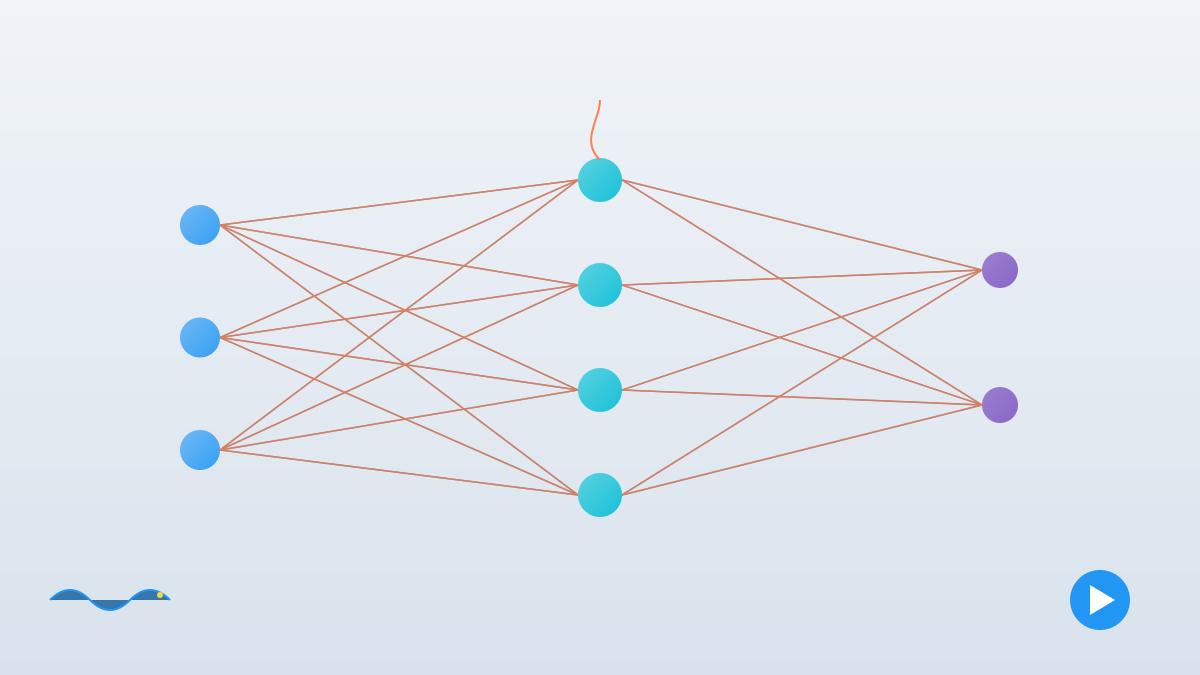
Technical Constraints: The core implementation uses only Python's standard libraries; NumPy, PyTorch, and other libraries are prohibited. Prioritize formulas before code—each concept must have mathematical formulas and examples before coding. Auxiliary functions should remain transparent. The model's learning effectiveness must be verified. Model Design: A single hidden layer MLP with an input layer of 5 neurons (corresponding to 5 features), a configurable hidden layer (default 6/8 neurons with ReLU activation), and an output layer of 1 neuron (for regression tasks). The loss function is MSE, and the optimizer is vanilla gradient descent. Course Outline: 12 progressive steps, from simple prediction to MLP backpropagation, training, and comparison with PyTorch.

4

Section 04

Practical Tasks and Validation Mechanisms

Practical Tasks: Select the UCI Bike Sharing Dataset (real scenario, intuitive, moderate scale). Extract 5 features such as hour and temperature; the target variable is the number of rentals. Use simple scaling strategies (e.g., hour/23, target/1000) to facilitate gradient understanding. Validation Mechanisms: 1. Gradient correctness: Compare numerical slopes (using the finite difference method) with hand-computed gradients. 2. Model effectiveness: After training, the model must outperform the average prediction baseline. Additional checklists include data inspection and loss reduction checks.

5

Section 05

Target Audience and Learning Recommendations

Target Audience: Deep learning beginners, developers switching majors, educators, and framework users (those confused about internal mechanisms). Learning Recommendations: Don't skip math—understand formulas before coding. Modify parameters (e.g., learning rate, hidden layer size) to observe their impacts. Use the finite difference method to verify gradients. After completing the project, compare it with a PyTorch implementation to deepen your understanding.

6

Section 06

Project Summary and Value

This project embodies the teaching philosophy of 'returning to the basics'. Implementing from scratch may seem inefficient, but it builds a solid foundation of understanding. Its value is not only in training a predictive model but also in fostering learners' intuition and confidence in neural networks. After mastering the underlying mechanisms, when using frameworks, you will clearly understand the essence of operations like .backward(), making this a high-quality project for learners who want to grasp the essence of deep learning.

