Zing Forum

Reading

End-to-End House Price Prediction System: A Machine Learning Web Application Based on Python and Flask

A complete end-to-end machine learning project that uses Python and scikit-learn to build a house price prediction model, and provides a user-friendly web interface via the Flask framework.

房价预测机器学习PythonFlaskscikit-learn回归分析端到端项目Web应用数据科学特征工程
Published 2026-06-01 08:15Recent activity 2026-06-01 08:24Estimated read 5 min
End-to-End House Price Prediction System: A Machine Learning Web Application Based on Python and Flask
1

Section 01

[Introduction] End-to-End House Price Prediction System: Building a Machine Learning Web Application with Python + Flask

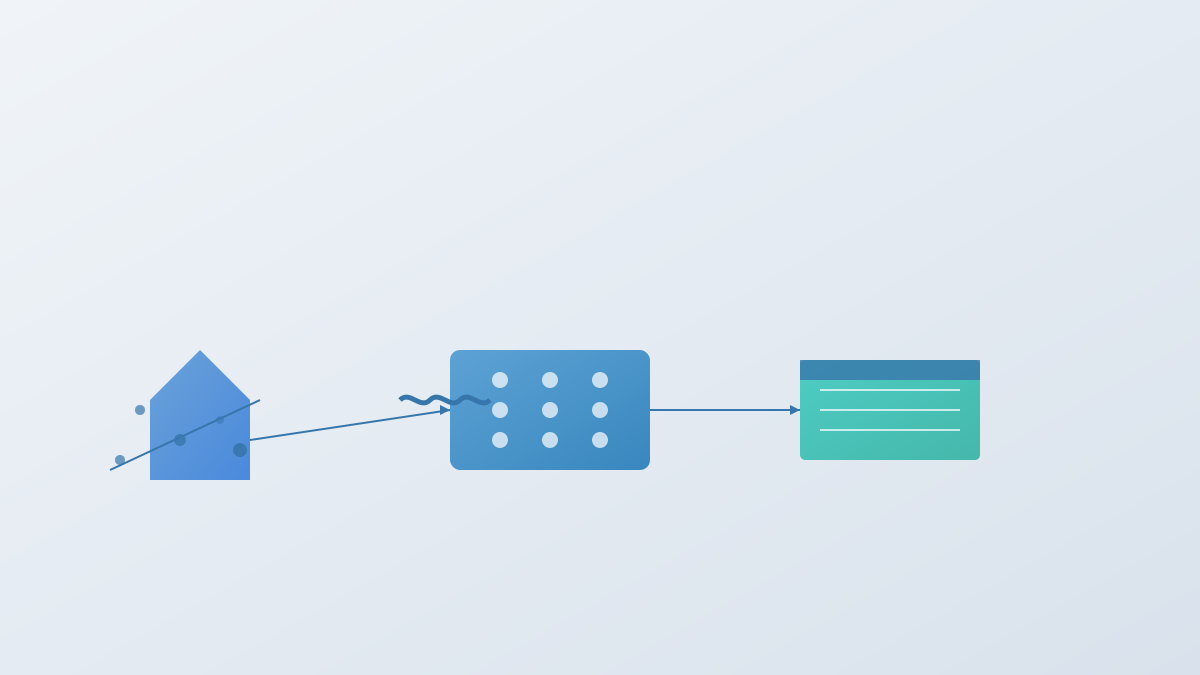
house-price-prediction is a complete end-to-end machine learning project that uses Python and scikit-learn to build a house price prediction model, and provides a user-friendly web interface via the Flask framework. The project covers the full workflow including data acquisition, feature engineering, model training, and web deployment, demonstrating the life cycle of a machine learning project from concept to product. It is suitable for data science beginners, real estate practitioners, and developers interested in machine learning applications.


2

Section 02

[Background] Application Value and Project Significance of House Price Prediction

House price prediction is a classic regression problem in machine learning with wide practical applications: personal home purchase decisions, real estate investment analysis, bank mortgage evaluation, government urban planning, etc. This project integrates the complete workflow to help users understand house price trends and provides decision support or learning cases for different user groups.

3

Section 03

[Methodology] Core Tech Stack and Implementation Workflow

Predictive Modeling: May use algorithms like linear regression, decision trees, random forests, gradient boosting, etc. Feature Engineering: Process features such as basic house attributes (area, number of bedrooms), geographic location, house condition, community environment, etc. Data Processing: Use Pandas (data loading/cleaning) and NumPy (numerical computation). Visualization: Analyze data via Matplotlib (histograms, scatter plots) and Seaborn (heatmaps, box plots). Web Application: Build the interface with Flask framework: users input house information → submit → backend model prediction → return results, lowering the threshold for use.

4

Section 04

[Evidence] Data Source and Model Evaluation Basis

Data Source: California real estate dataset, containing tens of thousands of records with rich features and distinct regional characteristics (high house prices, geographic diversity). Model Evaluation: Use RMSE (penalizes large errors heavily), MAE (intuitive), and R² (proportion of explained variance) metrics, and evaluate generalization ability via K-fold cross-validation.

5

Section 05

[Conclusion] Application Scenarios and User Value

Homebuyers: Evaluate the reasonableness of house prices, compare cost-effectiveness, guide house selection. Investors: Screen potential properties, evaluate renovation returns, compare strategies. Brokers: Provide pricing recommendations, generate analysis reports. Learners: Practice the complete machine learning workflow, learn data processing, model training, web deployment, etc.

6

Section 06

[Suggestions] Project Limitations and Improvement Directions

Limitations: Regional limitation (California data), timeliness (needs regular updates), incomplete feature coverage (lacks renovation details, etc.), model complexity to be improved. Improvement Directions: Expand data sources (Zillow API, etc.), introduce advanced features (image analysis, POI data), optimize models (XGBoost/LightGBM), enhance interaction (map visualization), optimize via A/B testing.

7

Section 07

[Supplementary] Tech Ecosystem and Learning Resources

Tech Ecosystem: scikit-learn (machine learning), Flask (web), Pandas/NumPy (data processing), Matplotlib/Seaborn (visualization). Learning Path: Master Python basics → NumPy/Pandas → Matplotlib → scikit-learn → Flask development.

