Zing Forum

Reading

proof2weights: A Bridge from Formal Proofs to Deployable Neural Networks

An open-source project that extracts neural network weights from Coq formal proofs into deployable formats, bridging the critical gap between neural network verifiability and real-world deployment.

形式化验证Coq神经网络权重提取AI安全可验证AI深度学习证明助手
Published 2026-05-27 09:06Recent activity 2026-05-27 09:20Estimated read 14 min
proof2weights: A Bridge from Formal Proofs to Deployable Neural Networks
1

Section 01

Introduction to proof2weights: A Bridge Connecting Formal Proofs and Deployable Neural Networks

proof2weights is an open-source project aimed at extracting neural network weights from Coq formal proofs and converting them into deployable formats, addressing the critical gap between neural network verifiability and real-world deployment. This project provides a reliable path from theoretical verification to practical application for AI systems in high-risk domains such as autonomous driving and medical diagnosis, and holds significant importance for AI safety and credibility engineering. The original author of the project is Charles C. Norton, and it is hosted on GitHub at the link: https://github.com/CharlesCNorton/proof2weights.


2

Section 02

Background: The Credibility Crisis of Neural Networks and the Role of Formal Verification

Modern deep learning systems are penetrating high-risk domains like medical diagnosis, autonomous driving, and financial risk control. However, these systems face a fundamental trust issue: while we know neural networks work, it is difficult to rigorously prove why they work and under what conditions they might fail. Formal verification is the ultimate solution to this problem. Through mathematical theorem proving, we can ensure that certain key properties of neural networks (such as safety and robustness boundaries) hold for all possible inputs. Coq, as a leading formal proof assistant in the industry, has been used to verify complex mathematical theorems and software systems. But there is a practical gap here: neural networks verified in Coq are an "existence in proof", while actual deployment requires model files that can run in frameworks like PyTorch and TensorFlow. How to convert the results of formal verification into executable, deployable code? This is exactly the problem the proof2weights project aims to solve.

3

Section 03

Project Overview: Core Goals and Value of proof2weights

proof2weights is an open-source toolchain focused on extracting neural network weights from Coq formal proofs and converting them into standard, deployable model formats. The core goal of the project is to build a reliable bridge between "formal verification" and "real-world deployment". The significance of this project lies in: it turns "mathematically proven correct neural networks" from a theoretical concept into practical systems that can be truly deployed in production environments. For safety-critical applications (like autonomous driving and medical AI), this verifiability may be the key turning point from "experimental technology" to "trustworthy product".

4

Section 04

Technical Principles: Representation in Coq, Challenges, and Solution Architecture

Neural Network Representation in Coq

In the Coq proof assistant, neural networks are defined as mathematical objects. Each layer, weight, and activation function has a precise mathematical definition. This representation allows us to:

  1. Strictly define network structure: The number of layers, number of neurons, and connection methods are clearly specified in the type system
  2. Prove key properties: We can prove statements like "For all inputs x, if x satisfies condition P, then output y satisfies condition Q"
  3. Extract computational content: Coq's extraction mechanism can convert constructive proofs into executable code

Challenges in Weight Extraction

Extracting neural network weights from Coq faces several technical challenges: Precision preservation: Real numbers in Coq may be arbitrary-precision mathematical reals, while real-world deployment usually uses IEEE 754 floating-point numbers. How to maintain numerical precision and the validity of proofs during extraction? Format conversion: Different deep learning frameworks use different weight storage formats (PyTorch's state_dict, TensorFlow's SavedModel, ONNX, etc.). proof2weights needs to support multiple output formats. Verification chain integrity: The extraction process itself needs to be trustworthy. If the extractor has bugs, the "verified" weights may be corrupted during conversion.

Solution Architecture

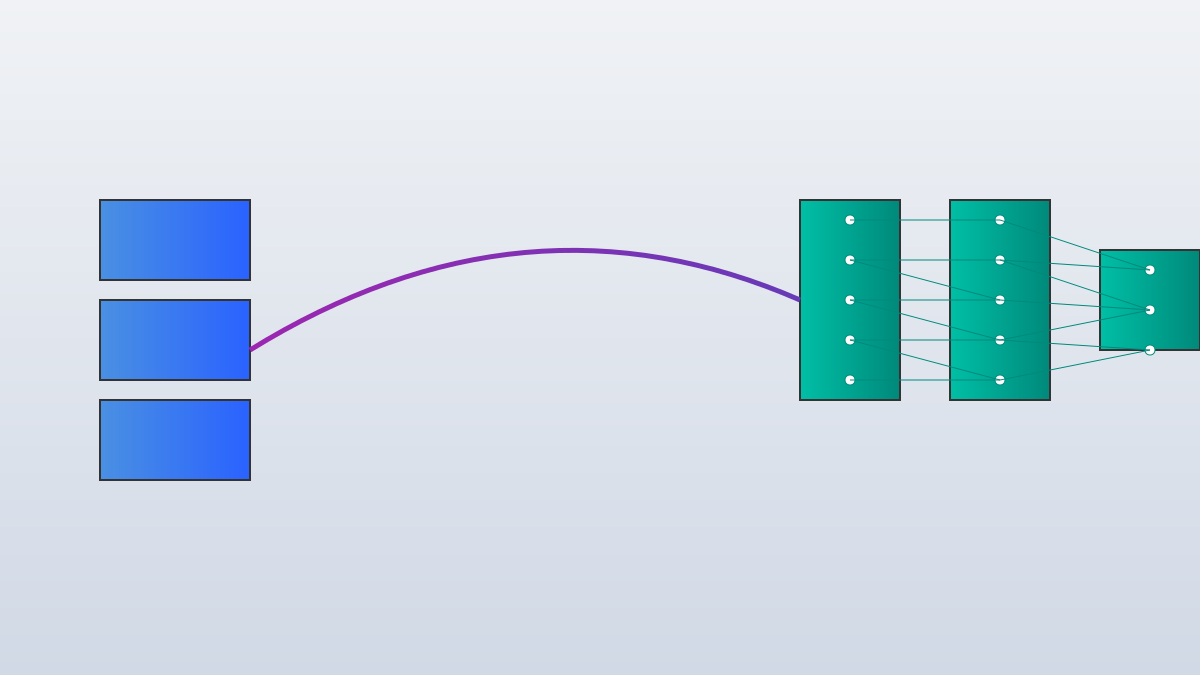
proof2weights adopts a modular architecture design:

  1. Coq interface layer: Defines a standard representation of neural network weights, decoupled from specific proof projects
  2. Extraction engine: Responsible for parsing weight values from Coq proof terms, handling type conversion and precision issues
  3. Format generator: Serializes the extracted weights into the format of the target framework
  4. Verification tool: An optional validation step to ensure the extracted weights are consistent with the original proof
5

Section 05

Practical Application Scenarios: Safety-Critical Systems and High-Reliability Services

Safety-Critical Systems

In the field of autonomous driving, the reliability of perception systems directly relates to life safety. Through proof2weights, we can:

  • Prove in Coq that "under specific lighting conditions, the false detection rate of the pedestrian detection network is below the threshold"
  • Extract the verified weights to the on-board computing platform
  • Deploy with formal guarantees to meet the requirements of functional safety standards (like ISO 26262)

High-Reliability AI Services

For scenarios like financial risk control and medical diagnosis, proof2weights enables:

  • The key decision logic of the model to be audited and verified
  • The deployed model to be completely consistent with the verified model, eliminating the "verification-deployment" gap
  • Meeting regulatory compliance requirements and providing mathematical-level credibility guarantees

Academic Research Reproducibility

In academic research, proof2weights can help:

  • Convert formal proofs in papers into runnable code
  • Promote cross-disciplinary collaboration between the formal methods and machine learning communities
  • Establish benchmark tests and comparative experiments for verifiable AI
6

Section 06

Technical Significance and Industry Impact: Driving the Development of Verifiable AI

proof2weights represents an important direction in AI credibility engineering. The "black box" nature of current AI systems is one of the main obstacles to their large-scale deployment. Formal verification provides a path to "white-box AI", and proof2weights makes this path practical. The potential impacts of this project include: Driving standardization of verifiable AI: If proof2weights becomes a de facto standard, it may spawn an ecosystem around "verifiable neural networks", including verification tools, certification processes, audit standards, etc. Lowering the threshold for formal methods: For machine learning engineers, the learning curve for Coq is steep. proof2weights provides a way for the results of formal verification to be used by a wider community without requiring everyone to be a proof expert. Promoting interdisciplinary collaboration: Connecting the formal verification community and the machine learning community to facilitate technical exchange and innovation between the two fields.

7

Section 07

Limitations and Future Directions: Scale, Ecosystem, and Industrial Integration

As an early-stage project, proof2weights also faces some practical challenges: Scale limitations: Currently, formal verification is mainly applicable to small networks. For large models with billions of parameters, complete Coq verification may be computationally infeasible. Future directions may include:

  • Modular verification: Verifying only key parts of the network
  • Approximate verification: Providing guarantees in a statistical sense
  • Hardware acceleration: Using GPUs to speed up proof checking

Ecosystem maturity: Coq's machine learning libraries are not as rich as the Python ecosystem. The development of proof2weights depends on the progress of the Coq community in neural network formalization.

Industrial integration: Integrating proof2weights into existing MLOps pipelines requires additional work, including CI/CD support, version management, monitoring, etc.

8

Section 08

Conclusion: The Forward-Looking Value of proof2weights

proof2weights is a forward-looking project that targets the core issue of AI system credibility. Although formal verification of neural networks is still an active research area, the toolchain provided by proof2weights moves this vision one step closer to practical application. For researchers and engineers concerned with AI safety, interpretability, and credibility, this project is worth paying attention to. It may represent a key component of future high-reliability AI systems: not only knowing that the model "works", but also being able to mathematically prove "why it works".

Project address: https://github.com/CharlesCNorton/proof2weights