Zing Forum

Reading

NeuroAssist: Neuromorphic Motor Intention Detection Using Spiking Neural Networks for Stroke Rehabilitation

This article provides an in-depth introduction to the NeuroAssist project, exploring how to use Spiking Neural Networks (SNNs) to implement neuromorphic computing for detecting motor intentions in stroke patients, offering an innovative solution at the intersection of rehabilitation medicine and brain-computer interface (BCI) technology.

脉冲神经网络神经形态计算脑机接口中风康复SNNBCI运动意图检测医疗AI
Published 2026-06-14 16:44Recent activity 2026-06-14 16:57Estimated read 10 min
NeuroAssist: Neuromorphic Motor Intention Detection Using Spiking Neural Networks for Stroke Rehabilitation
1

Section 01

Introduction to the NeuroAssist Project: Neuromorphic Computing and SNN-Driven Innovation in Stroke Rehabilitation

Project Core

NeuroAssist is a motor intention detection project for stroke patients based on Spiking Neural Networks (SNNs) and neuromorphic computing, aiming to provide an innovative solution at the intersection of rehabilitation medicine and brain-computer interface (BCI) technology.

Basic Information

Core Objectives

Leveraging the low-power and event-driven characteristics of SNNs to address the high power consumption and large latency issues of traditional BCI systems, enabling accurate motor intention detection to support rehabilitation training for stroke patients.


2

Section 02

Project Background: Challenges in Stroke Rehabilitation and Opportunities for BCI Technology

Current State of Stroke Rehabilitation

Stroke is one of the leading causes of disability in adults worldwide, with over 15 million people affected each year, and approximately 1/3 of them left with permanent motor impairments. Traditional rehabilitation relies on manual assistance from physical therapists, which has limitations such as insufficient training intensity, delayed feedback, and difficulty quantifying progress.

Potential of BCI Technology

Brain-computer interfaces (BCIs) decode motor intentions by reading brain signals and convert them into external device commands, which can provide immediate feedback and promote neuroplasticity. However, traditional BCIs have issues like high power consumption, large latency, and poor real-time performance, limiting their portable and long-term monitoring applications.

Birth of NeuroAssist

The project attempts to use neuromorphic computing and SNNs to address the pain points of traditional BCIs and explore more efficient rehabilitation solutions.

3

Section 03

Technical Foundation: Principles of Neuromorphic Computing and SNNs

Characteristics of Neuromorphic Computing

  • Event-driven: Active only when stimulated, reducing energy consumption;
  • Memory-computing fusion: Reduces data transfer overhead and breaks through the memory wall;
  • Parallel asynchronous processing: Suitable for processing spatiotemporal pattern data, directly matching brain spike signals.

Principles of SNNs

As the third generation of neural networks, SNNs are closer to biological neural operations:

  • Spike coding: Encodes information using the time/frequency of discrete spikes;
  • Time dimension: Explicitly processes sequential data, with neurons having membrane potential states;
  • Energy efficiency: Energy consumption under sparse spikes is much lower than traditional ANNs;
  • Hardware friendliness: Compatible with neuromorphic chips like Loihi and TrueNorth.

Challenges in SNN Training

Due to the non-differentiable nature of spike functions, methods like STDP, surrogate gradients, or ANN-to-SNN conversion are needed.

4

Section 04

Technical Path for Motor Intention Detection

Key Steps

  1. Signal Acquisition: Record brain activity using non-invasive EEG (scalp electrodes) or invasive ECoG (brain surface electrodes); EEG is preferred for rehabilitation scenarios;
  2. Preprocessing: Filtering (retaining 8-30Hz motor frequency bands), denoising (ICA to remove eye movement artifacts), re-referencing (average re-referencing);
  3. Feature Extraction: Extract ERD (Event-Related Desynchronization) and MRCP (Movement-Related Cortical Potentials), using time-frequency analysis to capture dynamic changes;
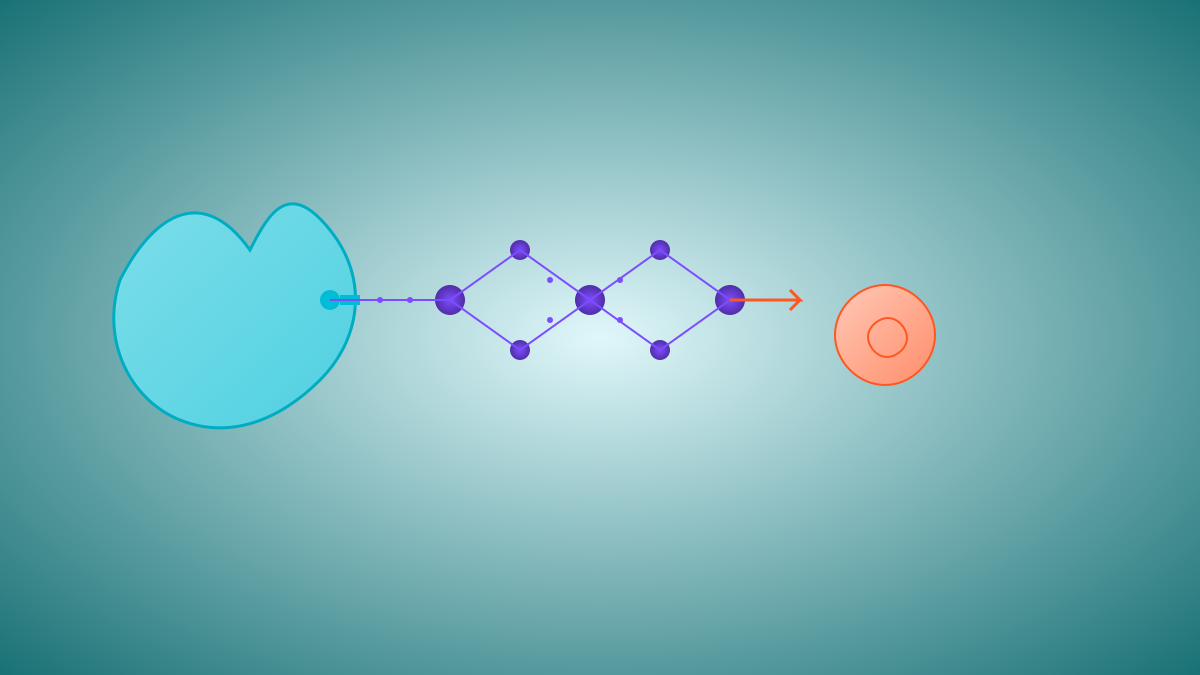
  4. SNN Decoding: Input layer encodes features into spike sequences, hidden layer processes spatiotemporal patterns, output layer classifies motor intentions;
  5. Intention Mapping: Convert SNN outputs into rehabilitation device commands (e.g., mechanical exoskeletons, electrical stimulators) to provide immediate feedback.
5

Section 05

Application Value and Clinical Significance

Core Value

  • Enhanced neuroplasticity: Synchronize motor intentions with feedback to strengthen neural pathway reconstruction;
  • Objective quantitative assessment: Record brain activity indicators to replace subjective scales and support adjustment of treatment plans;
  • Improved training intensity: Automated systems provide higher intensity and consistent feedback to accelerate rehabilitation;
  • Increased engagement: Mind-controlled devices enhance initiative and fun, improving compliance;
  • Early intervention: Provide a training pathway for severely paralyzed patients before muscle function recovery.
6

Section 06

Technical Challenges and Future Directions

Current Challenges

  • Signal stability: EEG is affected by electrode position and patient state, leading to large session-to-session variability;
  • Individual differences: Different injury sites/degrees in patients make personalized model training time-consuming;
  • Decoding accuracy: Misidentification may affect device control safety and user experience;
  • Long-term usability: Need to verify the system's long-term stability, comfort, and cost-effectiveness;
  • Regulatory approval: As a medical device, it needs to pass strict clinical trials and approvals.

Future Directions

  • Multimodal fusion: Combine EEG, EMG, and kinematic data to improve robustness;
  • Transfer learning: Use pre-trained models to reduce personalized calibration time;
  • Closed-loop adaptation: Adjust stimulation parameters and decoding models in real time;
  • Gamified rehabilitation: Integrate virtual reality games to increase engagement.
7

Section 07

Project Summary and Cutting-Edge Outlook

NeuroAssist represents cross-disciplinary innovation in neuromorphic computing, BCI, and rehabilitation medicine. By using SNNs to achieve low-power, low-latency motor intention detection, it provides an effective tool for stroke rehabilitation. Although many challenges remain from laboratory prototype to clinical product, such research points the way for neural rehabilitation technology and is a cutting-edge topic worth关注 in the field of AI medical applications.

