Zing Forum

Reading

NeuralNetworkVisualizer: Making Neural Network Learning Intuitive and Visual

A neural network visualization learning tool designed specifically for college students, helping them understand forward propagation, backpropagation, and training dynamics through interactive demonstrations.

神经网络可视化教育工具深度学习反向传播机器学习
Published 2026-05-13 02:24Recent activity 2026-05-13 02:30Estimated read 4 min
NeuralNetworkVisualizer: Making Neural Network Learning Intuitive and Visual
1

Section 01

NeuralNetworkVisualizer: An Intuitive Visualization Tool for Neural Network Learning

This post introduces NeuralNetworkVisualizer, a learning tool designed specifically for college students. It helps users understand core neural network mechanisms like forward propagation, backward propagation, and training dynamics through interactive demonstrations, addressing the difficulty of connecting abstract math formulas to real computing processes in traditional teaching.


2

Section 02

Project Background and Educational Challenges

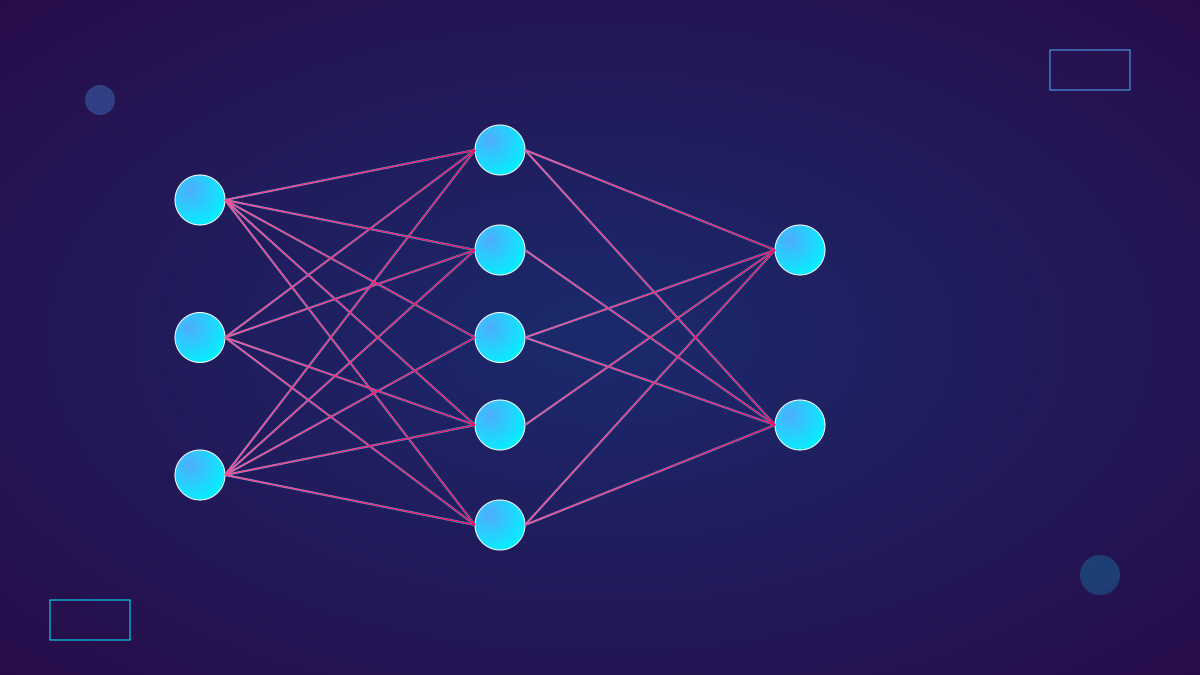
Traditional neural network teaching relies heavily on mathematical derivations and static diagrams, requiring strong spatial imagination and abstract thinking, which confuses many beginners. Developer GrantWass created this interactive platform to solve this problem, focusing on dynamic presentation of data flow and parameter updates besides static structure.

3

Section 03

Core Features and Technical Architecture

The tool has two main components: front-end visual interface (adjust parameters, observe real-time changes) and back-end ManualNeuralNetwork engine (implements forward propagation, loss evaluation, backward gradient update). Key features:

  • Forward propagation: Visualizes input data transformation through layers (weights, biases labeled).
  • Backward propagation: Animates error signal backflow and gradient-guided weight updates.
  • Training monitoring: Real-time loss curve and accuracy changes to show iterative optimization.
4

Section 04

Educational Value and Application Scenarios

Applicable to classroom teaching (interactive demos) and after-class self-study (repeated experiments). For self-learners, it provides a low-threshold environment to explore network structures, activation functions, and optimization strategies without complex coding.

5

Section 05

Technical Implementation Highlights

Modular design (core components as independent classes/functions for maintainability and extension). Code is clear with detailed comments, serving as a good reference. ManualNeuralNetwork backend is implemented from scratch without deep learning frameworks, prioritizing interpretability over efficiency—ideal for teaching.

6

Section 06

Summary and Future Outlook

NeuralNetworkVisualizer turns complex abstract concepts into interactive visual experiences, which will play a bigger role in lowering AI learning thresholds. It's an excellent starting point for learners to understand neural network principles; hands-on operation transforms abstract formulas into vivid processes, laying a foundation for advanced deep learning architectures.

