Zing Forum

Reading

KittyHawk: Exploration of a New Architecture for Interpretable Ternary Routed Neural Networks

KittyHawk is an open-source implementation of Ternary Routed Neural Networks. By restricting weights to {-1, 0, +1}, it achieves extreme compression and transparent interpretability, offering a new solution to the "black box" problem of neural networks.

三值神经网络Ternary Neural Networks可解释AI神经网络量化模型压缩边缘计算玻璃盒AI动态路由神经网络稀疏化
Published 2026-05-03 00:09Recent activity 2026-05-03 00:18Estimated read 7 min
KittyHawk: Exploration of a New Architecture for Interpretable Ternary Routed Neural Networks
1

Section 01

[Introduction] KittyHawk: A New Exploration of Interpretable Ternary Routed Neural Networks

KittyHawk is an open-source implementation of Ternary Routed Neural Networks. Its core lies in restricting weights to {-1,0,+1}, achieving extreme compression and transparent interpretability, thus providing a new solution to the "black box" problem of neural networks. It combines a dynamic routing mechanism to balance efficiency, interpretability, and expressive power, making it suitable for scenarios like edge computing. However, it also faces challenges such as the trade-off between accuracy and efficiency.


2

Section 02

Background: The "Black Box" Dilemma of Neural Networks and Exploration of Ternary Networks

Deep learning has achieved remarkable results, but the expansion of model scale has led to a prominent "black box" problem: inputs and outputs are visible, but the intermediate decision-making process is elusive, hindering debugging and optimization and causing trust crises in high-risk scenarios. Traditional floating-point weight networks have issues like high computational and storage costs and obscure mechanisms. Ternary neural networks are an important exploration direction for streamlined and transparent architectures.

3

Section 03

Technical Principles of KittyHawk: Ternary Quantization and Dynamic Routing

Ternary Quantization Principle

Weights are only -1 (negative contribution), 0 (disabled connection, dynamic sparsification), or +1 (positive contribution), conveying intensity and structural information.

Dynamic Routing Mechanism

Connection activation is dynamically determined by inputs. During training, both weight values and activation conditions are learned simultaneously to maintain sparsity and expressive power.

Efficient Forward Propagation

Multiplication is simplified to symbol judgment: +1 output equals the input, -1 is the negative of the input, and 0 skips the connection, greatly improving energy efficiency and making it suitable for edge deployment.

4

Section 04

Interpretability: The "Glass Box" Advantage of KittyHawk

Glass Box Design

The internal mechanism is transparent; the decision-making process can be inspected to understand the reasons behind predictions.

Connection Pattern Visualization

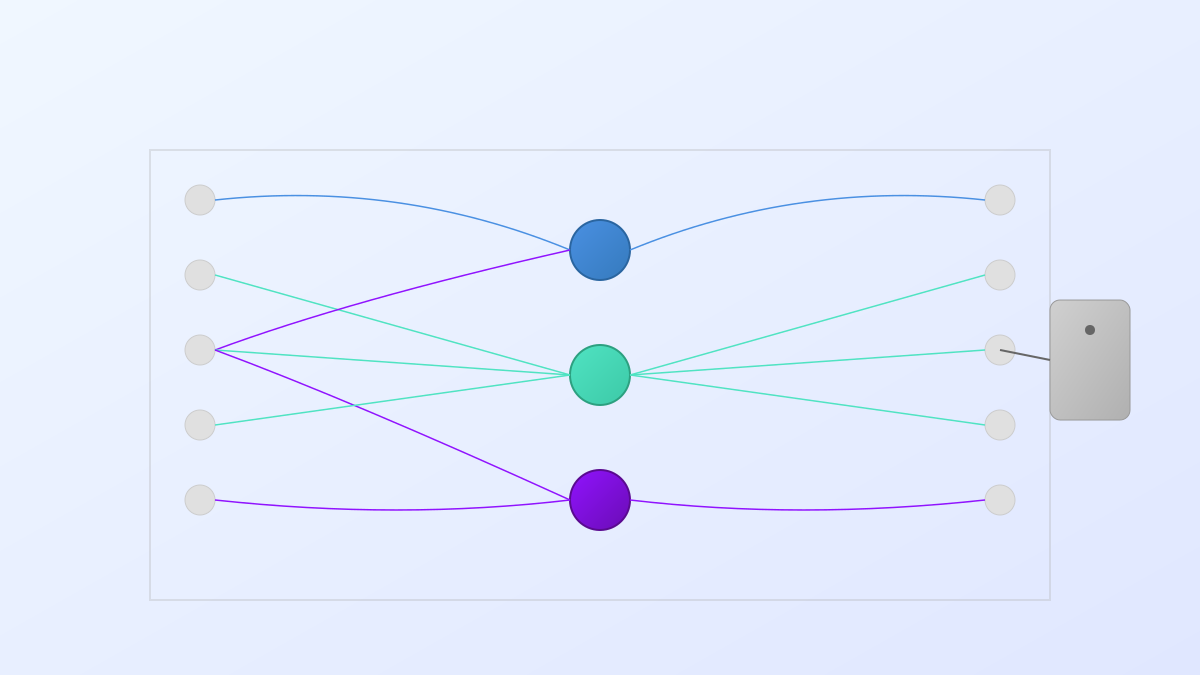
Connection diagrams can be drawn to observe positive/negative/no connections, analyzing feature learning, redundancy, or anomalies.

Formal Verification

Discrete weights and activations result in a limited output space, allowing verification of output constraints within input ranges, which is suitable for safety-critical scenarios.

5

Section 05

Application Scenarios and Potential Value of KittyHawk

  • Edge Computing and IoT: Extreme compression makes it suitable for resource-constrained devices, with small models and low energy consumption.
  • Model Interpretation and Debugging: Transparency helps locate anomalies in large models, accelerating development iterations.
  • Teaching and Prototype Verification: Visualization aids in understanding network behavior, and small models enable fast training to verify ideas.
  • Safety-Critical Systems: Interpretability and verifiability meet the needs of fields like autonomous driving and medical diagnosis.
6

Section 06

Technical Challenges and Future Development Directions

Accuracy-Efficiency Trade-off

Ternary quantization loses some expressive power; we need to explore mixed-precision designs, adaptive routing, and dedicated training algorithms to improve accuracy.

Hardware Acceleration

General-purpose processors are not optimized for ternary operations; dedicated ASICs or FPGAs need to be developed to unlock energy efficiency potential.

Integration with Large Models

It can be used to compress some layers of large models or serve as a lightweight proxy on the edge, forming a complementary relationship.

7

Section 07

Conclusion: Towards a More Transparent AI Future

KittyHawk represents a research paradigm different from the "bigger and stronger" trend, fundamentally rethinking neural network representation. It balances efficiency, interpretability, and expressive power, providing technical reserves for AI to move towards transparency and trustworthiness. It is valuable for developers, edge AI engineers, and researchers focusing on AI safety, opening a new window for neural network design.

