Zing Forum

Reading

GraphSSR: An Adaptive Subgraph Denoising Framework for Zero-Shot Graph Learning with Large Language Models

GraphSSR is an innovative two-stage reinforcement learning framework that enables large language models to perform zero-shot reasoning on unseen graph data through adaptive subgraph sampling and denoising mechanisms. This method has been accepted by the ACM SIGKDD 2026 Research Track.

graph learninglarge language modelszero-shot learningsubgraph denoisingreinforcement learningACM SIGKDD图神经网络大语言模型零样本学习强化学习
Published 2026-05-31 17:45Recent activity 2026-05-31 17:48Estimated read 6 min
GraphSSR: An Adaptive Subgraph Denoising Framework for Zero-Shot Graph Learning with Large Language Models
1

Section 01

[Introduction] GraphSSR: An Adaptive Subgraph Denoising Framework for Zero-Shot Graph Learning with LLMs

GraphSSR is an innovative two-stage reinforcement learning framework that enables large language models (LLMs) to perform zero-shot reasoning on unseen graph data through adaptive subgraph sampling and denoising mechanisms. This research has been accepted by the ACM SIGKDD 2026 Research Track, and the project code and datasets have been open-sourced.


2

Section 02

Background and Challenges: Core Difficulties in Integrating Graph Learning and LLMs

Limitations of Graph Learning

Traditional graph neural networks (GNNs) rely on large amounts of labeled data for training, and their performance drops sharply when dealing with out-of-distribution (OOD) graph structures.

Challenges of Applying LLMs to Graph Learning

Although LLMs have strong zero-shot reasoning capabilities, the structural characteristics of graph data differ greatly from natural language. How to effectively encode graph structures and avoid noise interference is an urgent problem to solve.

3

Section 03

Core Methods: Adaptive Subgraph Denoising and Two-Stage RL Training

Core Idea

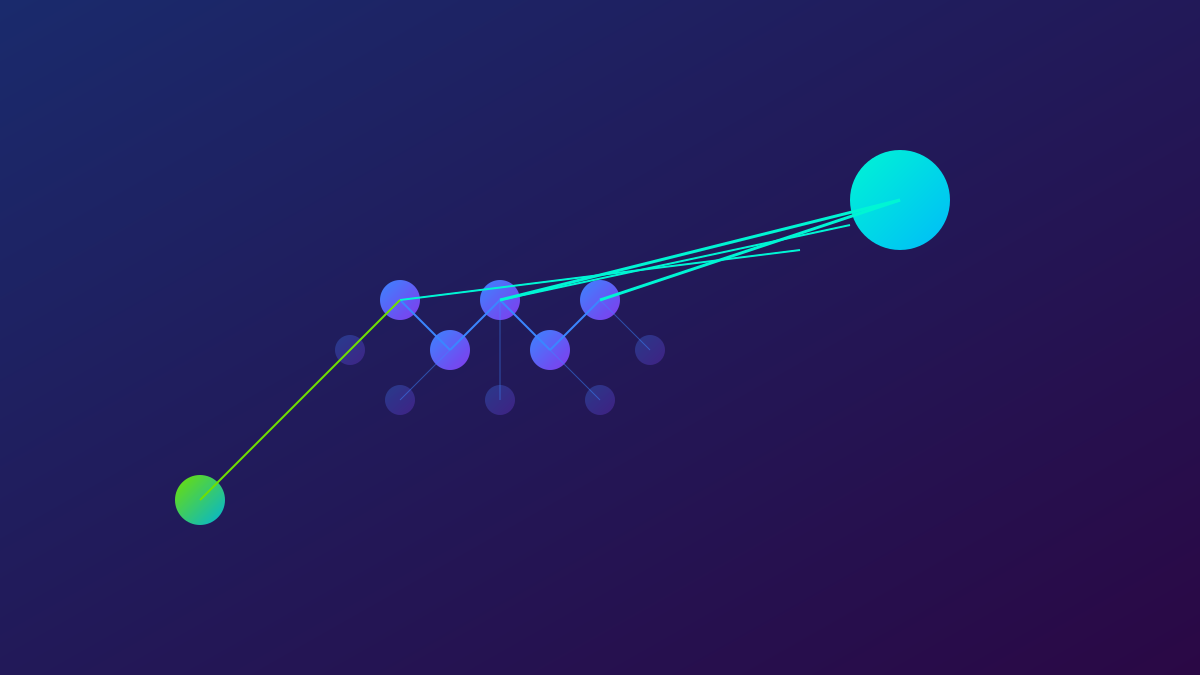
GraphSSR proposes an adaptive subgraph denoising paradigm, decomposing reasoning into three stages: Sample-Select-Reason, and dynamically adjusting the subgraph size to meet different problem requirements.

Two-Stage Reinforcement Learning Training

  1. Authenticity RL Stage: Ensures the model follows the reasoning process through three layers of verification: subgraph authenticity, selection consistency, and answer correctness.
  2. Denoising RL Stage: Introduces a structural conciseness reward to encourage the model to select more compact subgraphs, achieving adaptive adjustment.

Data Generation and Technical Implementation

  • Supervised Fine-Tuning (SFT): Constructs prompts based on the GraphR1 dataset, generates training data through teacher model reasoning and quality filtering.
  • Technical Framework: SFT uses LlamaFactory, RL is based on verl v0.6.x (custom loops and reward logic), and reasoning uses vLLM to deploy APIs.
4

Section 04

Evaluation Benchmark: Zero-Shot Testing on the GOFA Dataset

GraphSSR was evaluated on the GOFA (Graph Open Financial Analysis) benchmark dataset, which includes:

  • Main test set: 53,114 samples
  • Supplementary test set: 35,603 samples It covers various graph reasoning tasks and comprehensively tests zero-shot generalization capabilities.
5

Section 05

Significance and Applications: Cross-Modal Learning and Practical Scenario Value

Domain Significance

  • Proves that LLMs can effectively handle structured graph data, opening up new paths for cross-modal learning.
  • Adaptive subgraph selection improves model interpretability (explicitly showing the substructures that decisions depend on).

Application Scenarios

Applicable to knowledge graph question answering, drug molecular property prediction, social network analysis, recommendation systems, etc., especially valuable in cold-start scenarios where labeled data is scarce.

Key Insights

Task decomposition and progressive training, as well as adaptive mechanisms (teaching students according to their aptitude), are key to LLMs handling structured data.

6

Section 06

Summary and Supplementary Information

Summary

GraphSSR represents a cutting-edge exploration of the integration of graph learning and LLMs, improving zero-shot graph reasoning performance and providing a new perspective for understanding how LLMs handle structured data.

Supplementary Information