Zing Forum

Reading

GlimpsePrune: Dynamic Visual Token Pruning Technology for Large Vision-Language Models

Introduces GlimpsePrune, a dynamic visual token pruning method designed for large vision-language models, which significantly improves inference efficiency by intelligently compressing visual information while maintaining model performance.

视觉语言模型令牌剪枝模型压缩Transformer多模态AI推理优化南开大学
Published 2026-06-12 21:46Recent activity 2026-06-12 21:58Estimated read 5 min
GlimpsePrune: Dynamic Visual Token Pruning Technology for Large Vision-Language Models
1

Section 01

Introduction: Overview of GlimpsePrune Dynamic Visual Token Pruning Technology

The HVision-NKU team from Nankai University proposed GlimpsePrune, a dynamic visual token pruning method for large vision-language models (VLMs). Its core goal is to significantly improve inference efficiency while maintaining model performance by intelligently compressing visual information, addressing the deployment limitations of VLMs on edge devices and in real-time scenarios.


2

Section 02

Background: Efficiency Dilemma of Large Vision-Language Models

In recent years, VLMs such as GPT-4V, LLaVA, and Qwen-VL have achieved remarkable results in tasks like image understanding and visual question answering. However, processing high-resolution images requires a large number of visual tokens, leading to high inference latency and large memory usage, which severely limits their application on edge devices and in real-time scenarios.

3

Section 03

Core Method: GlimpsePrune's Dynamic Pruning Strategy

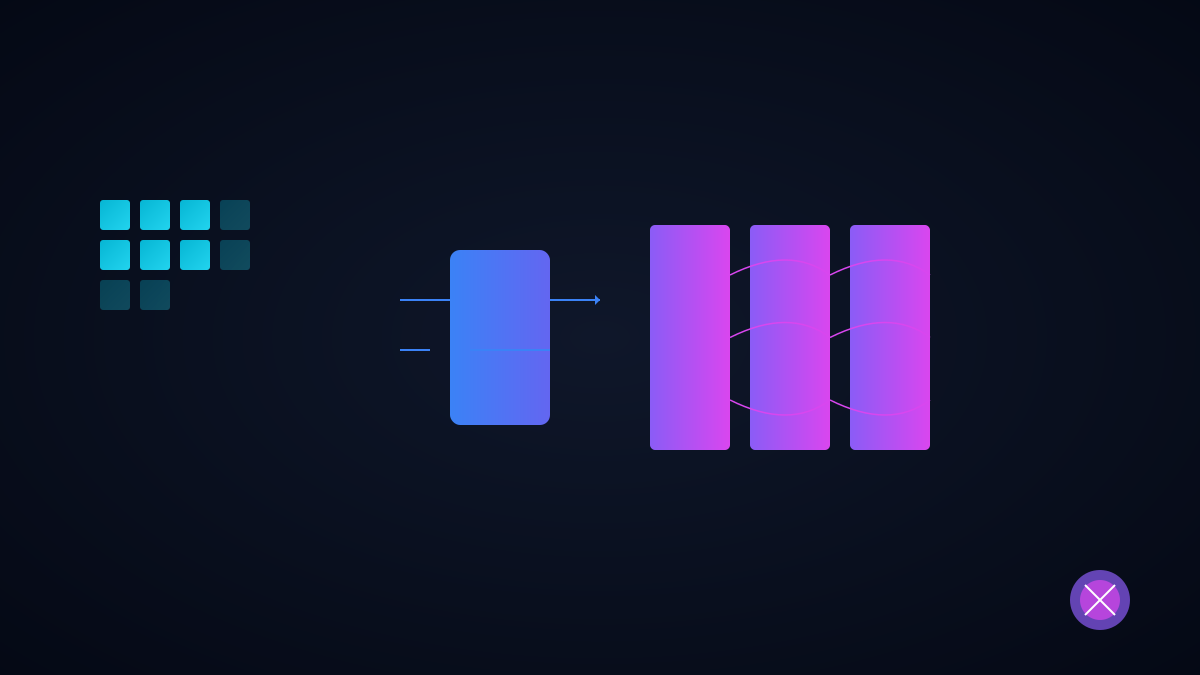
The core of GlimpsePrune is dynamic visual token pruning, which differs from static pruning in that it adaptively retains important tokens based on the content of the input image. Specific strategies include: 1. Importance scoring (based on attention weights, gradients, or scoring networks); 2. Hierarchical pruning (progressive refinement of information); 3. Task awareness (adjusting strategies according to tasks). It also addresses three key challenges: balancing information retention and compression, controlling pruning computation overhead, and compatibility with existing models (plug-and-play module).

4

Section 04

Why Do We Need Visual Token Pruning?

In VLMs, images are processed into visual tokens by visual encoders (e.g., ViT). A 224x224 image using 14x14 patches generates 256 tokens, and the number of tokens increases dramatically in high-resolution or multi-image scenarios. The self-attention complexity of Transformers is proportional to the square of the sequence length, so the growth of tokens leads to an explosive increase in computation and memory requirements.

5

Section 05

Application Scenarios: Practical Value of GlimpsePrune

This technology is applicable to: 1. Edge device deployment (mobile phones, IoT devices); 2. Real-time interactive applications (reducing response latency for visual question answering); 3. Batch image processing (saving time costs); 4. Multimodal large model services (reducing cloud computing costs and improving concurrency).

6

Section 06

Performance Expectations: Balance Between Efficiency and Performance

It is expected to reduce the number of visual tokens by 50% or more, while keeping the performance degradation within an acceptable range (e.g., within a few percentage points).

7

Section 07

Conclusion: Promoting Multimodal AI to Practical Applications

GlimpsePrune is an important progress in the field of VLM efficiency optimization, opening up new possibilities for the practical deployment of large models through dynamic token pruning. As multimodal AI becomes more popular, such efficiency optimization technologies will promote AI from the laboratory to a wider range of practical application scenarios.
