Zing Forum

Reading

clai: A Local LLM Interaction Tool in the Command Line

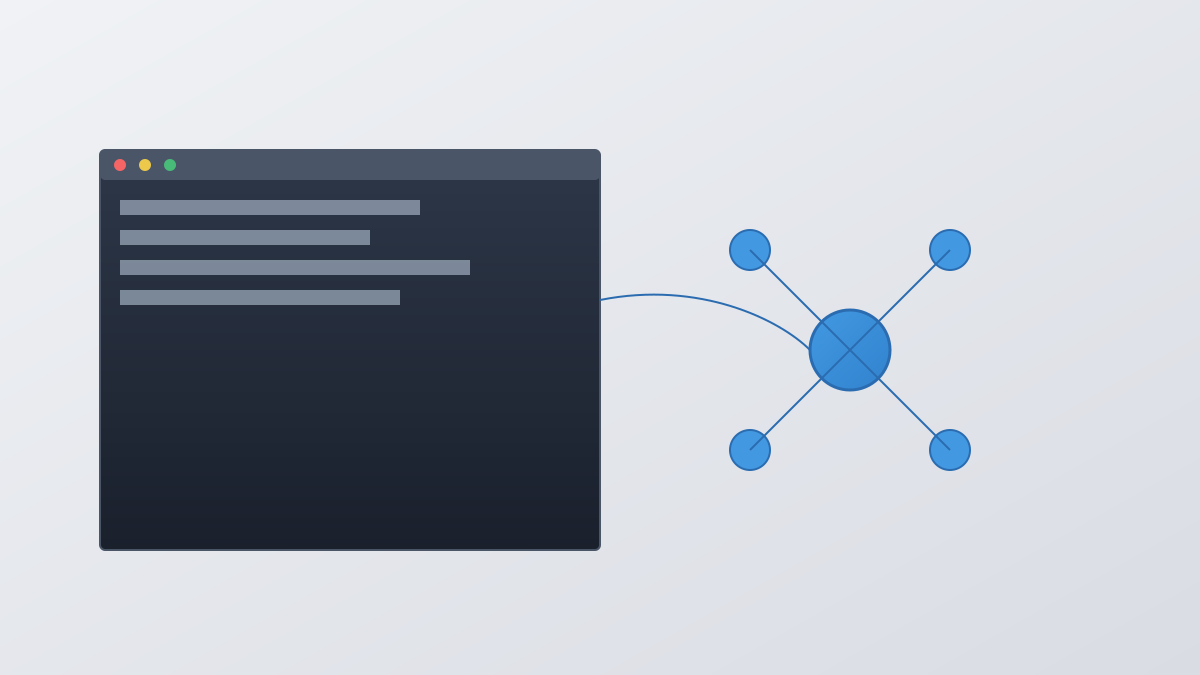
clai is a local large language model (LLM) interaction tool designed specifically for command-line environments. It allows users to directly invoke LLM capabilities in the terminal without opening a browser or launching heavyweight applications.

LLM命令行工具本地AI开源项目开发者工具终端上下文感知
Published 2026-05-03 13:43Recent activity 2026-05-03 13:53Estimated read 6 min
clai: A Local LLM Interaction Tool in the Command Line
1

Section 01

clai: Introduction to the Local LLM Interaction Tool in the Command Line

clai is a local large language model (LLM) interaction tool designed specifically for command-line environments. It aims to solve the pain point for developers who need to switch between browsers or heavyweight applications when relying on LLMs. Its core features include context awareness (capturing terminal environment information), local model support (protecting privacy and enabling offline use), and deep command-line integration (seamless collaboration with other tools), helping developers efficiently utilize AI capabilities in the terminal and improve workflow efficiency.


2

Section 02

Background and Development Motivation of clai

With the popularization of LLMs, developers rely on AI to assist with programming and other tasks. However, existing interaction methods require opening browsers or desktop clients, causing context switching for developers who are accustomed to working in the terminal and reducing efficiency. The clai project was thus born to bring LLM capabilities into the command-line environment and achieve seamless workflow integration.

3

Section 03

Core Features and Working Mechanism of clai

The core features of clai include: 1. Context awareness: Intelligently captures information such as the current directory, recent commands, and environment variables, passing them to the LLM to provide relevant suggestions; 2. Local model support: Runs open-source models (e.g., Llama, Mistral) via frameworks like Ollama and llama.cpp, without the need for cloud APIs, making it suitable for sensitive data and offline scenarios; 3. Command-line integration: Supports pipeline operations and scripted calls, enabling collaboration with other tools to build automated workflows.

4

Section 04

Practical Application Scenarios of clai

The application scenarios of clai include: 1. Code review and explanation: Parsing unfamiliar code snippets (e.g., regular expressions, Shell scripts); 2. Document generation: Generating function documentation, README files, etc., based on the context of the codebase; 3. Troubleshooting: Analyzing error outputs and providing solutions in combination with the environment; 4. Learning assistance: Acting as an interactive tutor to answer questions related to programming languages or frameworks.

5

Section 05

Key Technical Implementation Points of clai

The technical implementation of clai involves: 1. Context collection: Safely and efficiently collecting terminal information while avoiding sensitive data leakage; 2. Prompt engineering: Designing effective templates to convert context into a format understandable by the model; 3. Streaming output: Displaying responses in real time to enhance the interactive experience; 4. Configuration management: Supporting multiple model providers and parameter configurations; 5. Error handling: Gracefully handling exceptions such as network interruptions and model loading failures.

6

Section 06

Comparison of clai with Similar Command-Line LLM Tools

Comparison of clai with similar tools: 1. aichat: A multi-platform client with rich features; 2. ollama: Focused on local model operation; 3. shell-gpt: A Shell assistant based on the OpenAI API. The uniqueness of clai lies in its deep focus on context feeding capabilities and its design philosophy of natively supporting local models.

7

Section 07

Summary and Future Outlook of clai

clai represents the direction of deeply embedding AI capabilities into daily workflows. Its context awareness and local model support make it stand out. In the future, clai is expected to continue evolving in aspects such as supporting more model formats, enriching context types, and enhancing integration with other development tools, helping developers utilize AI more efficiently.

